
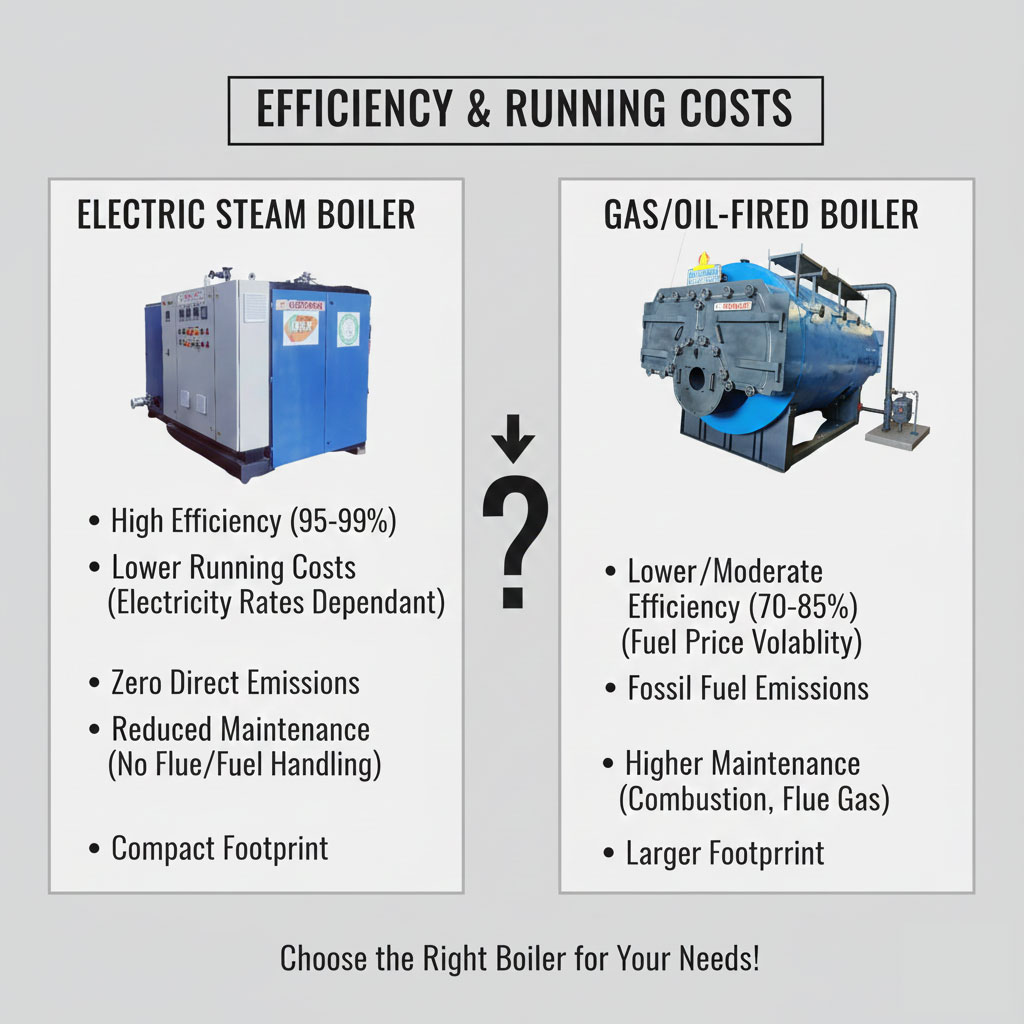
“Electric boilers are more efficient” is technically true and practically incomplete. A 99% efficiency rating tells you almost nothing about what you’ll actually pay to run the equipment over its working life — that depends on your electricity tariff, your fuel access, your maintenance discipline, and a handful of cost categories that never show up on an efficiency spec sheet at all.
This piece breaks down the real cost comparison between ELECTROMAX – Electric IBR Steam Boiler and STEAMJET – Oil/Gas Fired Steam Boiler — not just the headline efficiency percentage, but everything that sits underneath it. If you haven’t yet settled on electric technology as the right direction at all, our complete guide to industrial electric steam boilers is worth reading first.
1. Efficiency: Where the Gap Actually Comes From
Boiler efficiency answers one specific question: how much of the input energy actually becomes usable steam?
ELECTROMAX typically achieves 98–99% operational efficiency. Nearly all the electrical energy consumed converts directly into heat within the water — there’s no flue gas carrying heat away unused, no radiation loss from a hot combustion chamber, and no standby loss from maintaining a flame between demand cycles. Steam generation begins almost immediately on demand, which also minimizes the startup and shutdown energy waste that batch-cycling combustion systems experience.
STEAMJET typically runs 80–90% efficient, and that gap is entirely structural, not a manufacturing quality issue. Flue gas losses — heat escaping up the chimney with exhaust — are the dominant factor. Radiation losses from the hot boiler shell and combustion chamber add more. Blowdown losses, necessary to remove dissolved solids from the water, take a further small cut. Pushing fuel-fired efficiency above 90% is achievable, but it requires additional equipment — economizers, air preheaters — that adds to upfront cost rather than coming standard.
The honest takeaway: on paper, electric wins the efficiency comparison decisively. But efficiency alone doesn’t determine your running cost — what you’re converting matters just as much as how well you convert it.
2. Running Costs: The Categories Efficiency Doesn’t Capture
Fuel and Energy Cost
Electricity pricing in India is generally more stable and predictable in the short term than fossil fuel pricing, particularly under industrial tariff structures — and there’s no fuel procurement, transport, or storage logistics to manage at all. The trade-off is that electricity can carry a higher cost per unit of thermal energy delivered than some fossil fuels, which is often the first objection raised against electric systems. That gap narrows meaningfully for plants with access to favorable industrial tariffs, or ones pairing the boiler with captive solar or wind generation.
Fossil fuel pricing for oil and gas, by contrast, is genuinely volatile — subject to international markets, geopolitical events, and domestic taxation shifts that make multi-year cost forecasting difficult. On top of the fuel price itself, procurement, transportation, storage infrastructure, and handling all add real cost that doesn’t show up in a simple per-litre or per-scm comparison.
Maintenance Cost
This is where the gap consistently favors electric, and for structural reasons rather than marketing claims. With no combustion, ELECTROMAX has no burners to clean, no soot accumulating on heat exchange surfaces, and no exhaust system to maintain — the primary maintenance items are heating elements, contactors, and control systems, which are simpler and less frequent to service. There’s also no refractory lining to inspect or repair, a genuinely costly recurring item on fuel-fired systems.
STEAMJET requires regular burner, flue, and heat-transfer-surface cleaning to hold its rated efficiency, periodic refractory inspection and repair, and generally more intensive upkeep on fans, pumps, and auxiliary combustion equipment.
Environmental and Regulatory Cost
ELECTROMAX produces zero on-site emissions — no NOx, SOx, or particulate matter — which eliminates the need for emission control equipment, ongoing stack monitoring, and often simplifies the environmental clearance process for new installations.
STEAMJET, like any combustion system, must meet emission norms, which can require investment in flue gas treatment, continuous emission monitoring systems, and ongoing compliance reporting depending on your state’s specific requirements and your plant’s scale.
Space and Installation Cost
ELECTROMAX‘s compact footprint needs less boiler room space and a simpler installation — no chimney, no fuel lines, no large ventilation system to engineer around.
STEAMJET requires space for the boiler itself, fuel storage tanks, a chimney, and associated auxiliary equipment, along with more extensive civil work for foundations, chimney erection, and fuel line installation.
3. Putting It Together: A Framework, Not a Universal Answer
There’s genuinely no single right answer here — the correct choice depends on which of these factors carries the most weight for your specific operation.
ELECTROMAX tends to be the stronger choice when: you prioritize high efficiency, zero on-site emissions, and minimal maintenance; your facility has access to favorable industrial electricity tariffs or renewable generation; you operate in a hygiene-sensitive sector like food, pharma, or biotech, or in an environment where an open flame is a genuine safety concern; or you need fast startup and precise, staged control.
STEAMJET tends to be the stronger choice when: you have access to genuinely economical and stable gas or fuel oil supply; you need very high steam capacity where upgrading electrical infrastructure to match would be prohibitively expensive; or your overriding priority is the lowest possible cost per thermal unit of fuel, and you’re prepared to accept the higher maintenance and environmental compliance overhead that comes with it.
Our electric steam boiler sizing guide covers how to work through the capacity and electrical infrastructure side of this decision in more detail once you’ve settled on a general direction.
4. Frequently Asked Questions
What is an Electric IBR Steam Boiler? It’s a steam-generating vessel using electrical energy for heating, designed, manufactured, and certified to meet Indian Boiler Regulations under the current Boilers Act, 2025. IBR certification becomes mandatory once a unit’s water capacity or operating pressure crosses the thresholds set out in the Act.
What’s the difference between ELECTRON and ELECTROMAX? ELECTRON is our non-IBR range, suited to smaller-scale applications below the regulatory threshold. ELECTROMAX is our IBR-certified range, built for higher-pressure, higher-volume industrial steam requirements.
Why is IBR certification necessary? Once a boiler’s water capacity or operating pressure crosses the thresholds defined in current regulation, certification ensures the unit meets required standards for material quality, welding integrity, and pressure-bearing capacity — this isn’t optional paperwork, it’s a legal operating requirement.
Do I need to register an IBR-certified electric boiler? Yes. Any IBR-certified boiler must be registered with the relevant State Boiler Inspectorate. We assist with the necessary documentation as part of installation.
How often does an IBR boiler need inspection? Under current regulation, boilers require periodic inspection to renew their fitness certificate — our post on the Boilers Act, 2025 covers the current inspection and renewal timeline in detail.
Does an electric boiler need a chimney? No. Without fuel combustion, there’s no smoke or exhaust gas, which eliminates the need for a chimney, associated air pollution permits, and ducting entirely.
Are electric boilers quieter than fuel-fired units? Yes — without burners, blowers, or fuel pumps, electric systems like ELECTROMAX operate far more quietly, which matters for facilities near residential areas or noise-sensitive work environments.
What are the main safety features on an IBR electric boiler? Standard features typically include dual safety valves to prevent over-pressurization, a water level controller for low-water cutoff protection, and over-current protection safeguarding the heating elements — always confirm exact specifications for your specific unit with our engineering team.
How do I maintain the heating elements? Scale buildup is the primary maintenance concern for resistance-element electric boilers — a water softener is essential, along with periodic checking of electrical terminals and routine blowdown to remove accumulated sludge. Where scale is a particular concern due to hard local water, our INDUCTRON induction-based design avoids much of this issue entirely, since its heating core never directly contacts the water.
What’s the typical ROI logic for switching to electric steam? While electricity cost per unit can run higher than some fossil fuels, the return case typically comes from reduced labor requirements (no dedicated fireman needed), lower maintenance spend, higher operational efficiency, and the complete elimination of fuel storage and handling costs — the actual payback period depends heavily on your specific tariff and current fuel costs, so it’s worth requesting a tailored ROI analysis rather than relying on a generic industry figure.
What capacity, pressure, and pricing options are available? Capacity, maximum working pressure, and pricing all depend on your specific steam demand, automation level, and current material costs — rather than quote general figures here that could be outdated or misleading by the time you read this, we’d recommend requesting a current, tailored quote directly. Contact our team with your required steam output (kg/hr) and working pressure for an accurate, up-to-date proposal.
Conclusion: Efficiency Is the Headline, Total Cost Is the Real Answer
The efficiency gap between electric and fuel-fired steam generation is real and consistently in electric’s favor — but running cost is a broader question involving fuel or energy pricing, maintenance burden, regulatory overhead, and installation complexity, all weighted differently depending on your specific operation and location. Neither ELECTROMAX nor STEAMJET is a universally correct answer; the right choice follows your actual fuel access, electrical infrastructure, and regulatory environment.
Balkrishna Boilers Pvt Ltd manufactures both technologies and can walk through a proper cost comparison specific to your plant rather than a generic industry estimate. Explore the full range on IndianBoilers.com or Balkrishn.com.
Ready for a tailored efficiency and cost comparison for your specific operation? Contact our engineering team with your steam output and pressure requirements for a detailed proposal.