
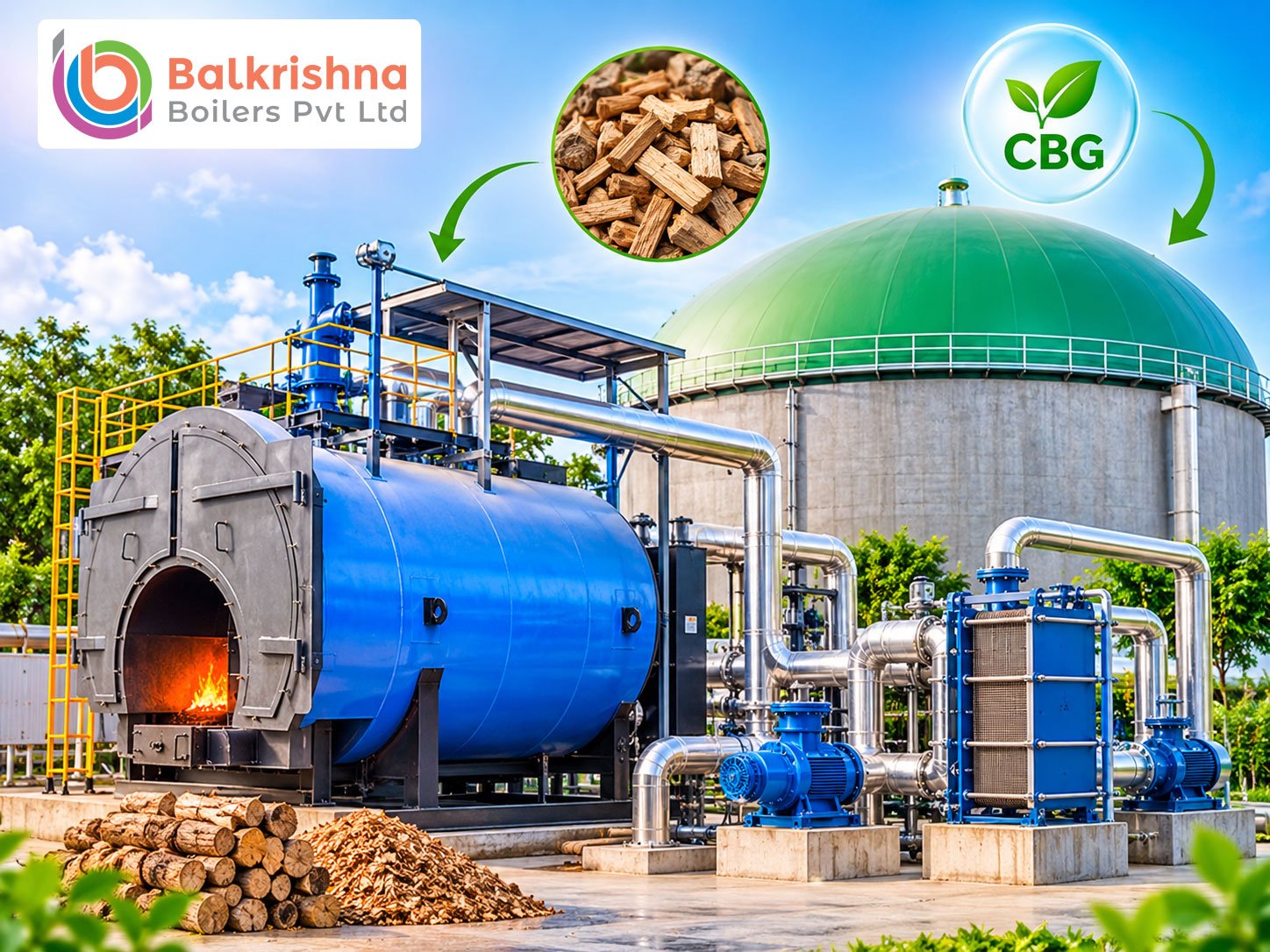
Introduction
Compressed Biogas (CBG) is becoming an important part of India’s transition towards cleaner and more sustainable energy. With increasing interest in renewable fuels, agricultural waste management and organic waste utilization, CBG plants are gaining attention across the country.
However, producing biogas efficiently requires more than just an anaerobic digester and organic feedstock. Temperature management is one of the most important factors influencing the performance of a biogas plant.
Inside an anaerobic digester, microorganisms break down organic matter in an oxygen-free environment and produce biogas containing methane and carbon dioxide. These microorganisms are sensitive to temperature fluctuations. If the digester becomes too cold, biological activity slows down. If the temperature rises excessively or changes suddenly, the microbial balance can be disturbed.
This is where an industrial hot water boiler becomes an important part of the CBG plant infrastructure.
A properly designed hot water heating system supplies the thermal energy required to maintain the desired digester operating temperature. It supports stable biological activity, consistent gas production and reliable plant operation.
For industrial applications requiring dependable hot water circulation, selecting the right hot water boiler for CBG plants is essential. Balkrishna Boilers offers specialized heating solutions designed to support digester temperature requirements and biomass-based heating applications.
In this article, we explain how hot water boilers work in CBG plants, why temperature control matters, how heating systems are designed, and what plant developers should consider when selecting a suitable industrial hot water boiler.
1. Why Does a CBG Plant Require a Hot Water Boiler?
A CBG plant generally processes organic materials such as cattle dung, agricultural residues, food waste, press mud and other biodegradable feedstocks.
These materials are mixed with water or recycled slurry to prepare feedstock for anaerobic digestion.
During digestion, microorganisms convert biodegradable organic matter into biogas. However, their activity depends heavily on maintaining suitable operating conditions, particularly temperature.
Most conventional anaerobic digesters operate in one of two temperature ranges:
Mesophilic Digestion
- Typical operating temperature: 35–40°C.
- Offers relatively stable biological activity.
- Commonly used in many commercial biogas installations.
- Generally provides a practical balance between gas production and operating requirements.
Thermophilic Digestion
- Typical operating temperature: 50–55°C.
- Supports faster biological reactions under suitable conditions.
- Requires more heating energy and tighter process control.
- Needs careful management of temperature fluctuations and microbial stability.
The actual operating temperature depends on digester design, feedstock characteristics, process technology and engineering recommendations.
In Indian climatic conditions, maintaining digester temperature can be challenging during winter, particularly in northern and western regions.
Even when the outside temperature changes, the digester must maintain its required operating conditions.
An industrial hot water boiler supplies the heat required to compensate for thermal losses and maintain the desired temperature.
Without a properly designed heating arrangement, a CBG plant may experience:
- Reduced microbial activity.
- Slower organic matter decomposition.
- Fluctuations in biogas production.
- Longer digestion periods.
- Unstable plant performance.
- Increased process recovery time after temperature disturbances.
Therefore, a dependable hot water heating system is an essential consideration during CBG plant planning.
2. How Does a Hot Water Boiler Support Anaerobic Digestion?
An industrial hot water boiler generates heated water and circulates it through a designated heating circuit.
In a CBG plant, the heated water generally transfers thermal energy to the digester slurry through a heat exchanger, heating jacket, external circulation arrangement or another process-specific heating system.
The hot water does not necessarily mix directly with the digester material. An indirect heat-transfer arrangement is commonly preferred because it maintains separation between the heating medium and the digestion process.
The typical heating arrangement involves the following steps:
Step 1: Water Heating
The hot water boiler receives return water from the circulation system. Fuel combustion inside the furnace transfers heat to the water through the boiler heating surfaces.
Step 2: Hot Water Circulation
A circulation pump delivers heated water towards the digester heating circuit.
Step 3: Heat Transfer
The thermal energy passes through a heat exchanger or digester heating surface and increases the temperature of the organic slurry.
Step 4: Temperature Monitoring
Temperature sensors monitor the digester operating temperature. A suitable control system regulates the heating demand according to process requirements.
Step 5: Return Water Circulation
After transferring heat, the cooler water returns to the boiler for reheating.
This continuous circulation process helps maintain a stable thermal environment inside the digester.
The heating arrangement must be engineered according to digester volume, insulation, feedstock temperature, ambient conditions and required operating temperature.
3. Important Features of a Hot Water Boiler for CBG Plants
A CBG plant generally operates continuously, making heating-system reliability an important consideration.
The boiler should be selected according to the plant’s actual heat requirement rather than only its nominal capacity.
Some important features include:
A. Consistent Hot Water Supply
The boiler must deliver sufficient heat to compensate for digester heat losses and incoming feedstock heating requirements.
A stable hot water supply helps maintain the biological process without unnecessary temperature fluctuations.
B. Biomass Fuel Compatibility
Many CBG plants are located in agricultural regions where biomass fuels may be available locally.
Depending on the boiler design, suitable fuels can include:
- Wood logs.
- Biomass briquettes.
- Agricultural biomass residues.
- Other approved solid fuels.
Using locally available biomass can provide an alternative to conventional fossil fuels.
Fuel selection should consider calorific value, moisture content, ash characteristics, availability and handling requirements.
For plants looking for renewable fuel-based heating solutions, a biomass-fired hot water boiler is another option worth exploring. These systems utilize suitable solid biomass fuels to generate hot water for industrial process heating.
C. Efficient Heat Transfer
The boiler should provide effective heat transfer between the combustion gases and water.
A properly engineered multi-pass heat exchanger helps utilize available heat efficiently and reduces avoidable stack losses.
D. Automatic Temperature Control
Temperature control is particularly important in anaerobic digestion.
A suitable control arrangement can regulate the heating system based on hot water supply temperature, return temperature and digester temperature.
This helps avoid excessive heating and supports consistent process operation.
E. Reliable Water Circulation
Adequate circulation is essential for transferring heat from the boiler to the digester.
The pump should be selected according to required flow rate, system pressure drop, piping distance and heat exchanger requirements.
F. Easy Cleaning and Maintenance
Solid-fuel-fired boilers generate ash and combustion deposits.
Easy access to smoke tubes, furnace areas and ash collection points helps simplify maintenance and maintain heat-transfer performance.
4. How to Calculate the Heating Requirement of a CBG Plant
One of the most important steps in selecting a hot water boiler is calculating the actual thermal requirement.
Choosing an undersized boiler can result in inadequate heating, while excessive capacity can increase capital investment and operating expenses.
The heating requirement generally consists of three major components:
- Heat required to raise the incoming feedstock temperature.
- Heat lost through the digester walls, roof and floor.
- Heat losses through pipes, heat exchangers and other connected equipment.
Feedstock Heating Calculation
The approximate heat required to increase feedstock temperature can be calculated using:
Q = m × Cp × ΔT
Where:
- Q = Heat energy required (kcal).
- m = Mass of feedstock (kg).
- Cp = Specific heat capacity (kcal/kg°C).
- ΔT = Required temperature rise (°C).
For example, consider a CBG plant receiving 20,000 kg of feedstock per day.
Assume:
- Feedstock quantity = 20,000 kg/day.
- Initial feedstock temperature = 25°C.
- Required temperature = 37°C.
- Temperature difference = 12°C.
- Assumed specific heat = 1 kcal/kg°C.
The daily heat requirement is:
Q = 20,000 × 1 × 12
Q = 240,000 kcal/day
This is the approximate sensible heat required to raise the feedstock temperature.
The actual boiler requirement will be higher because digester heat losses, piping losses and heat exchanger losses must also be considered.
Heat Loss Calculation
Digester heat losses depend on several factors:
- Digester dimensions.
- Insulation thickness and material.
- Ambient temperature.
- Wind exposure.
- Surface temperature.
- Foundation and underground construction.
- Heating pipe insulation.
A properly insulated digester reduces the continuous heating requirement and helps control energy consumption.
Selecting Boiler Capacity
After calculating the total hourly heat requirement, the boiler capacity can be selected with an appropriate engineering margin.
For preliminary calculations:
Boiler Capacity (kcal/hr) = Total Hourly Heat Requirement ÷ Overall Useful Heat Utilization Factor
The final selection should also consider peak heating demand, startup conditions, redundancy requirements and actual operating schedules.
A detailed heat-load calculation by the project engineering team is recommended before finalizing the boiler.
5. Why Choose a Biomass-Fired Hot Water Boiler for a CBG Plant?
Biomass-fired hot water boilers can be an attractive option for CBG projects located near agricultural and biomass-producing regions.
These systems use solid biomass fuels to generate hot water for industrial heating applications.
Some major advantages include:
Lower Dependence on Fossil Fuels
Plants with access to affordable biomass can reduce dependence on diesel, furnace oil or other conventional heating fuels.
Utilization of Agricultural Resources
Wood and biomass briquettes can provide a productive use for locally available biomass resources.
Continuous Heating Capability
A correctly sized boiler can support continuous hot water circulation and maintain the required digester temperature.
Flexible Fuel Selection
Depending on furnace and grate design, certain boilers can accommodate different solid fuels.
Industrial-Grade Construction
A properly designed hot water boiler provides a dedicated heating system for long-duration industrial operations.
However, biomass is not automatically the cheapest option in every location. The final operating cost depends on delivered fuel price, moisture content, calorific value, boiler efficiency, ash handling and operating labour.
For applications requiring wood log and biomass briquette firing, the VTFH Series biomass-fired hot water boiler from Balkrishna Boilers is another industrial heating solution worth considering, subject to the project’s required capacity and operating conditions.
6. AQUAMAX: Hot Water Boiler for CBG Plant Applications
Balkrishna Boilers offers an industrial hot water boiler solution designed for biomass-based heating applications in CBG plants.
The AQUAMAX hot water boiler is designed to utilize wood logs and biomass briquettes for generating hot water required by industrial heating systems.
It is particularly relevant for CBG plants that need a dependable source of thermal energy for digester heating.
Key Features of the AQUAMAX Series
- Biomass and wood-fired heating arrangement.
- Integral furnace for effective heat transfer.
- Three-pass smoke tube design.
- Fully wet-back configuration.
- Forced-draft primary air fan.
- Secondary air ducting for improved combustion.
- Electrically driven water circulation pumps.
- Hinged smoke chamber for easier tube cleaning and ash removal.
- Industrial construction for continuous heating applications.
Operating Range
The AQUAMAX range offers:
- Heating capacity: 4 lakh to 20 lakh kcal/hr.
- Fuel options: Wood logs and biomass briquettes, with other compatible solid fuels subject to design.
- Standard hot water temperature: Up to 90°C.
- Special designs: Higher temperature applications up to 160°C, depending on the selected configuration.
The actual boiler model should be finalized after evaluating the required heat load, water circulation rate, operating temperature and project conditions.
Explore the AQUAMAX wood and biomass briquette-fired hot water boiler from Balkrishna Boilers for high-capacity industrial heating requirements.
For additional product details, visit the Hot Water Boiler for CBG Plant product page.
7. Factors to Consider Before Selecting a CBG Plant Hot Water Boiler
Selecting the right boiler requires evaluating the complete heating system rather than focusing only on boiler capacity.
1. Digester Volume
The size and number of digesters influence the total heat requirement.
Larger digesters generally have greater surface areas and may require more thermal energy to maintain the desired operating temperature.
2. Daily Feedstock Quantity
Incoming feedstock continuously introduces material at a temperature that may be lower than the digester operating temperature.
Higher feedstock quantities can increase the heating requirement.
3. Local Climate
Plants operating in colder regions may experience higher heat losses during winter.
Seasonal temperature variation should be considered during boiler sizing.
4. Fuel Availability
The availability and price of wood logs, biomass briquettes and other approved fuels can influence the final heating-system selection.
5. Boiler Efficiency
Boiler efficiency affects the quantity of fuel required to generate a given amount of useful heat.
Fuel moisture, combustion control, excess air, heat-transfer surface condition and flue gas temperature all influence actual performance.
6. Circulation Pump Selection
The pump must provide sufficient hot water flow through the heating circuit.
Incorrect pump selection can cause poor heat distribution, inadequate temperature control and unnecessary electrical consumption.
7. Automation and Safety
The boiler should include suitable temperature controls, water-level protection, pressure-relief devices, circulation interlocks and other safety arrangements according to its design.
Proper instrumentation also makes routine monitoring easier.
8. Alternative Heating Requirements
Some industrial facilities may prefer electric heating depending on electricity availability, energy costs and site requirements.
For such applications, the ELECTRO AQUA electric hot water boiler provides an alternative industrial hot water heating option.
8. Common Problems in CBG Plant Heating Systems
Even a correctly selected boiler can experience operational difficulties if the overall heating system is poorly maintained.
Some common problems include:
Insufficient Digester Temperature
This can occur due to inadequate boiler capacity, low fuel quality, poor insulation or insufficient hot water circulation.
Uneven Heating
Improper heat exchanger design, poor flow distribution or inadequate circulation can result in temperature differences within the digester.
Excessive Fuel Consumption
High fuel consumption may indicate heat losses, wet biomass, poor combustion, fouled heat-transfer surfaces or incorrect operating practices.
Pump Failure
Circulation pump failure can interrupt heat delivery and disturb digester temperature.
Scale Formation
Water-side scaling can reduce heat transfer and increase operating temperatures in affected surfaces. Proper water treatment and routine inspection are important.
Ash and Soot Accumulation
Solid-fuel-fired boilers require regular cleaning to maintain combustion and heat-transfer efficiency.
A preventive maintenance schedule should cover boiler inspection, pump servicing, fuel-system checks, water quality, safety devices and temperature instrumentation.
For projects considering different hot water boiler configurations and capacities, the VTMH Series hot water boiler can also be evaluated according to the application’s specific thermal requirements.
9. Why Proper Insulation and Heat Distribution Matter
A common mistake during CBG plant development is concentrating entirely on boiler capacity while overlooking heat distribution.
The boiler may generate sufficient hot water, but excessive losses in the piping network can reduce the heat actually reaching the digester.
To improve overall heating performance:
- Insulate hot water supply and return pipelines.
- Minimize unnecessary pipe lengths and bends.
- Select appropriately sized heat exchangers.
- Maintain proper circulation rates.
- Monitor supply and return water temperatures.
- Insulate exposed digester surfaces.
- Check valves, flanges and pipeline joints for heat losses.
Good insulation and hydraulic design can reduce boiler loading and improve overall plant energy performance.
10. Why Choose Balkrishna Boilers for CBG Plant Heating Requirements?
Selecting a boiler manufacturer with industrial heating experience is important when designing a reliable CBG plant.
Balkrishna Boilers Pvt. Ltd. manufactures industrial boilers and heating systems for different industrial applications.
Its product portfolio includes biomass-fired steam boilers, hot water boilers, thermic fluid heaters, electric boilers and hot air generators.
For CBG projects, the AQUAMAX hot water boiler provides a biomass-based heating option for maintaining process water temperature.
The boiler selection can be evaluated according to:
- Required thermal capacity.
- Feedstock heating requirements.
- Digester operating temperature.
- Fuel availability.
- Hot water circulation requirements.
- Site installation conditions.
- Automation and safety requirements.
Explore the complete range of industrial hot water boilers at IndianBoilers.com and discover additional heating solutions through Balkrishna Boilers’ hot water boiler product range.
A properly engineered heating system can help CBG plant operators maintain stable process conditions while managing their overall thermal energy requirements.
Conclusion
Temperature management is one of the foundations of efficient anaerobic digestion. A CBG plant needs a reliable heating arrangement to maintain suitable digester conditions, compensate for thermal losses and support consistent biological activity.
An industrial hot water boiler provides the thermal energy required for this purpose.
For projects where wood and biomass briquettes are locally available, a biomass-fired hot water boiler can be a practical heating solution.
Balkrishna Boilers’ AQUAMAX series is designed for industrial hot water applications, including CBG plant heating requirements.
By considering digester volume, daily feedstock quantity, insulation, circulation flow, fuel quality and operating temperature during boiler selection, project developers can build a more dependable and energy-conscious CBG heating system.
Looking for a Hot Water Boiler for Your CBG Plant?
Contact Balkrishna Boilers Pvt. Ltd. for assistance in selecting a suitable industrial hot water boiler based on your plant’s thermal requirements.
Website: https://www.indianboilers.com/
Product: https://www.indianboilers.com/product/hot-water-boiler-for-cbg-plant/
Phone: +91 7383705055
Email: info@indianboilers.com
Frequently Asked Questions (FAQs)
1. Why is a hot water boiler required in a CBG plant?
A hot water boiler supplies thermal energy to maintain the required temperature inside anaerobic digesters. Stable temperature supports microbial activity and consistent biogas production.
2. What is the ideal temperature for a biogas digester?
Mesophilic digesters generally operate around 35–40°C, while thermophilic digesters typically operate around 50–55°C. The exact temperature depends on the digestion technology and feedstock.
3. Which boiler is suitable for a CBG plant?
A biomass-fired hot water boiler can be suitable for CBG plants requiring continuous heating and having access to wood logs or biomass briquettes.
4. Can a biomass-fired boiler maintain digester temperature?
Yes. A properly sized biomass-fired hot water boiler can provide heated water through a circulation and heat-exchanger arrangement to maintain the required digester temperature.
5. What fuels can be used in the AQUAMAX hot water boiler?
The AQUAMAX range is designed for wood logs and biomass briquettes. Other fuels should be evaluated against the specific furnace design and manufacturer recommendations.
6. What is the capacity range of the AQUAMAX hot water boiler?
The AQUAMAX range offers heating capacities from 4 lakh to 20 lakh kcal/hr, depending on the selected model.
7. How can boiler fuel consumption be reduced in a CBG plant?
Fuel consumption can be optimized through proper boiler sizing, good-quality fuel, effective combustion control, regular tube cleaning, adequate insulation and efficient hot water circulation.
8. Does a CBG plant need automatic temperature control?
Automatic temperature monitoring and control are highly useful for maintaining stable digester conditions. The control system should be designed according to the plant’s process requirements.
9. Can hot water be circulated through a digester heating system?
Yes. Hot water can circulate through a heat exchanger, heating jacket or other suitable indirect heating arrangement to transfer heat to the digester slurry.
10. How do I select the correct hot water boiler capacity for my CBG plant?
Boiler capacity should be calculated using feedstock quantity, incoming temperature, target digester temperature, heat losses, insulation, circulation requirements and peak heating demand. A detailed engineering assessment is recommended.