
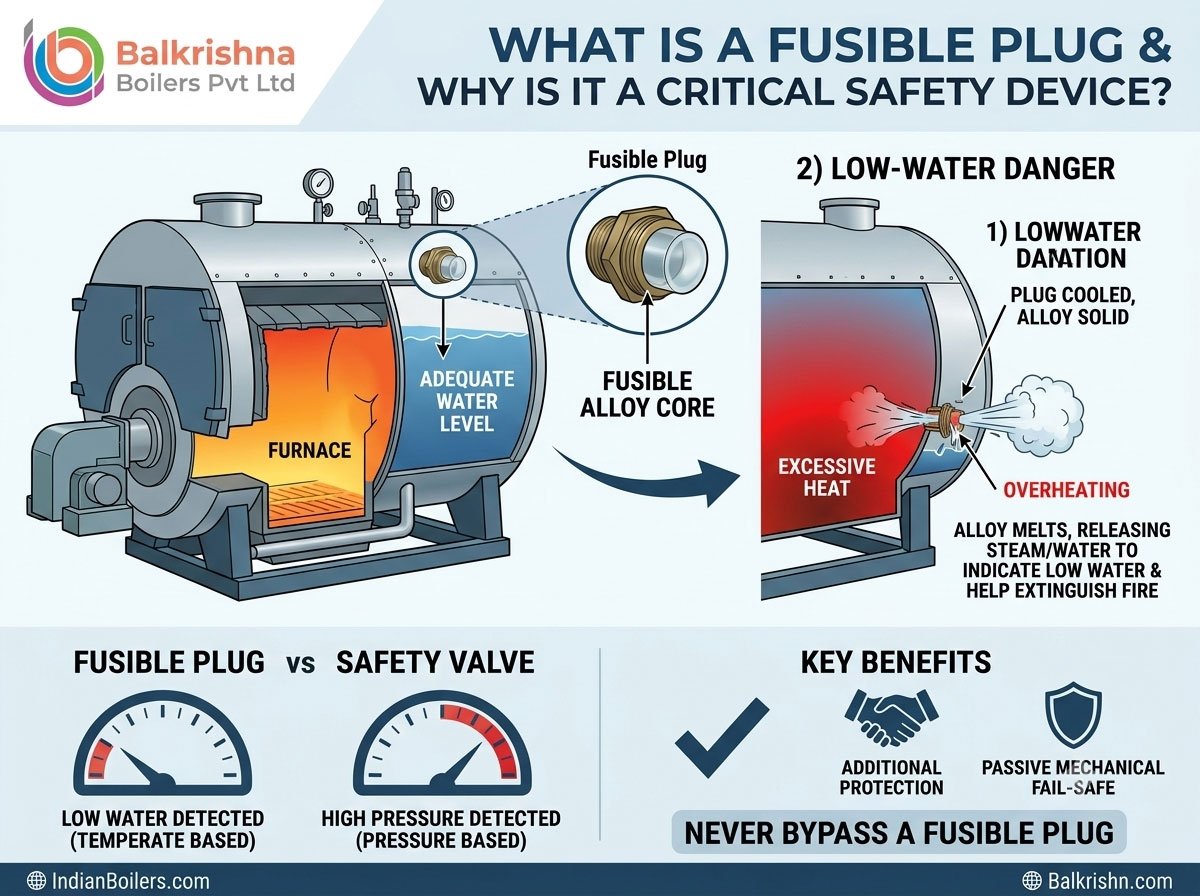
A fusible plug in a boiler is a safety device designed to help protect a boiler against dangerous overheating caused by a critically low water level. Although relatively small compared with the size of an industrial boiler, a fusible plug has an important role in boiler safety because it provides an additional layer of protection when water falls below a safe level and the furnace-side heating surface becomes excessively hot.
Industrial steam boilers operate with large quantities of hot water and pressurized steam. Because of the amount of thermal energy stored inside a pressurized boiler, maintaining the correct water level is fundamental to safe operation. Modern boilers therefore use multiple safety systems, including water-level controls, alarms, pressure controls, safety valves and other protective interlocks. A fusible plug is one of the traditional safety devices used to provide protection against low-water conditions.
For a broader introduction to boilers, see our guide on What Is a Steam Boiler? Definition, Working, and Types. It explains how boilers convert water into steam and why pressure, water level and heat transfer are central to boiler operation.
This article explains what a fusible plug is, how it works, where it is installed, why low water is dangerous, how it differs from a safety valve, and why modern boiler protection should use multiple independent safety systems.
What Is a Fusible Plug in a Boiler?
A fusible plug is a small safety component installed at a strategic location in a boiler, typically where it can sense excessive temperature associated with an unsafe low-water condition.
The plug generally consists of a metal body containing a fusible alloy. The alloy is selected to melt at a predetermined temperature. Under normal operating conditions, the surrounding boiler water keeps the plug sufficiently cool.
If the boiler water level drops below the intended safe level, the portion of the boiler containing the fusible plug can become exposed to the hot combustion gases. The temperature of the plug then rises significantly.
When the fusible alloy reaches its melting temperature, it melts and releases the material or opens the passage through the plug. Depending on the boiler design, this can allow steam or water to escape toward the furnace area and produce a visible warning or help extinguish the fire, indicating that an abnormal low-water condition has occurred.
The key principle is simple:
Adequate water level → plug remains cooled → normal operation
Dangerously low water level → plug overheats → fusible alloy melts → safety action occurs
A fusible plug should therefore be understood as an additional safety layer, rather than a replacement for modern water-level controls or operator monitoring.
Why Is a Fusible Plug Necessary?
A steam boiler is designed to transfer heat from combustion gases to water. Under normal conditions, water covers the heat-transfer surfaces and absorbs the heat generated in the furnace.
The situation changes dramatically when the water level falls too low.
When heating surfaces are no longer adequately covered with water, they cannot transfer heat away as effectively. Metal temperatures can rise rapidly. Continued firing under such conditions can result in severe thermal stress, deformation or damage to boiler components.
This is why low-water protection is one of the most important principles in steam-boiler safety.
Our Steam Boiler Maintenance Checklist for Indian Factories discusses the importance of routine boiler checks and operator discipline, particularly under Indian operating conditions where water quality, fuel variability and environmental conditions can influence boiler performance.
A fusible plug provides another physical layer of protection against this type of abnormal condition.
How Does a Fusible Plug Work?
The working principle of a fusible plug is based on temperature-sensitive melting.
Step 1: Normal Boiler Operation
During normal operation, the boiler contains an adequate quantity of water.
The water covers the relevant heating surfaces and keeps the fusible plug relatively cool.
The fusible alloy remains solid.
Step 2: Water Level Falls
A failure involving the feedwater system, level-control equipment, operator error, leakage or another abnormal condition can cause the boiler water level to fall.
If the water falls below the safe operating range, parts of the heating surface may become exposed to the furnace’s high-temperature gases.
Step 3: Fusible Plug Temperature Increases
Once the plug is no longer adequately cooled by water, heat from the furnace can cause its temperature to increase rapidly.
This is the fundamental sensing mechanism.
The fusible plug does not normally require an electrical sensor or electronic control system to detect this temperature condition.
Step 4: Fusible Alloy Melts
When the temperature reaches the specified melting point of the fusible alloy, the alloy melts.
This changes the physical condition of the plug and activates its intended protective function.
Step 5: Abnormal Condition Becomes Evident
The resulting release of steam or water, depending on the particular design and installation, can alert operators to the low-water condition and/or help interrupt the dangerous condition.
The boiler should then be shut down and inspected according to the manufacturer’s operating and emergency procedures.
Where Is a Fusible Plug Installed?
The location of a fusible plug is extremely important.
It is generally positioned so that it remains covered by water during normal operation but becomes exposed to high-temperature furnace gases when the water level falls below a predetermined safe level.
This location allows the plug to respond indirectly to a low-water condition.
The exact location depends on the boiler design, pressure-vessel configuration and applicable engineering requirements. Therefore, fusible plugs should never be relocated, modified or replaced with an incorrectly specified component without approval from the boiler manufacturer or qualified engineer.
For industrial applications, the safety arrangement should always be considered as a complete system rather than as an isolated component.
What Happens When a Fusible Plug Melts?
A melted fusible plug is not simply a routine maintenance event.
It should be treated as an indication that an abnormal temperature or low-water condition may have occurred.
The appropriate response depends on the specific boiler design and manufacturer’s instructions, but generally the boiler should not simply be restarted because the plug has melted.
The boiler should be:
- Shut down according to the emergency procedure.
- Isolated from the heat source.
- Allowed to cool under controlled conditions.
- Inspected by qualified personnel.
- Checked for possible low-water causes.
- Examined for overheating or damage to heating surfaces.
- Fitted with the correct replacement fusible plug if required.
- Returned to service only after the cause has been identified and the boiler is considered safe.
Never bypass a fusible plug or replace it with an ordinary metal plug.
The fusible alloy and construction are part of the safety function.
Fusible Plug vs Safety Valve: What Is the Difference?
Fusible plugs and safety valves are both boiler safety devices, but they address different hazards.
| Safety Device | Primary Purpose |
|---|---|
| Fusible Plug | Protects against dangerous overheating associated with low water |
| Safety Valve | Protects against excessive steam pressure |
| Low-Water Cut-Off | Detects low water level and can stop firing |
| Pressure Switch | Controls or monitors boiler pressure |
| Water-Level Controller | Maintains boiler water within the required operating range |
| Flame Failure Device | Stops fuel supply when proper combustion/flame is lost |
A safety valve responds primarily to excessive pressure.
A fusible plug responds primarily to excessive temperature at its location, which can result from inadequate water coverage.
This distinction is important because a boiler can experience a low-water condition without necessarily exceeding its normal pressure setting.
Modern industrial steam boilers therefore rely on a combination of protective systems rather than one device performing every safety function.
Why Low Water Is Dangerous in a Steam Boiler
Understanding the importance of the fusible plug requires understanding the danger of low water.
The boiler furnace generates very high temperatures. Water normally absorbs heat from the boiler’s heating surfaces.
When sufficient water is present, the heating surfaces can transfer heat into the water.
If the water level falls significantly:
- Heat transfer conditions change.
- Metal temperatures can increase.
- Boiler tubes or plates can experience excessive thermal stress.
- Localized overheating can occur.
- Material strength can be affected.
- Severe equipment damage may result if firing continues.
This is why water-level monitoring is fundamental to boiler operation.
Our article How to Prevent Boiler Explosions: A Safety Guide discusses the relationship between pressure, water level, maintenance and boiler safety in greater detail.
Modern Boilers Use Multiple Safety Layers
It is important not to view a fusible plug as the only safety system on a modern industrial boiler.
Modern boiler safety generally combines mechanical, electrical and automatic protection.
Depending on the boiler design, these can include:
1. Water-Level Controls
Water-level instruments continuously monitor the boiler’s water level.
If the water level falls outside the permitted range, the control system can generate an alarm or initiate a protective shutdown.
2. Low-Water Cut-Off
A low-water cut-off can interrupt the burner or heating system when water falls below a defined level.
This is particularly important because it can prevent continued firing during an unsafe condition.
3. Safety Valves
Safety valves provide protection against excessive pressure by releasing steam when pressure reaches the specified set point.
4. Pressure Controls
Pressure switches and transmitters monitor operating pressure and can regulate firing or initiate shutdown sequences.
5. Flame-Failure Protection
Fuel-fired boilers can incorporate flame-monitoring systems that shut off fuel if the required flame is not detected.
6. Automatic Interlocks
Modern PLC-based control systems can monitor multiple parameters simultaneously, including:
- Water level
- Steam pressure
- Fuel pressure
- Flame status
- Feedwater flow
- Furnace conditions
- Temperature
- Fan operation
- Pump operation
Balkrishna Boilers’ steam-boiler range includes modern safety controls and monitoring systems. Its Steam Boiler range on Balkrishn.com covers multiple configurations and fuel types.
Is a Fusible Plug Still Relevant in Modern Boilers?
The answer depends on the boiler design, applicable regulations, manufacturer specifications and engineering requirements.
Modern boilers increasingly use sophisticated electronic monitoring and automatic protection systems. However, a mechanical or passive safety device can still provide an additional independent layer of protection where it is specified by the design.
The important principle is:
Do not assume that modern automation makes basic safety devices unnecessary.
Likewise, a fusible plug should not be treated as a substitute for electronic water-level protection.
The complete safety philosophy should be based on redundancy, independent protection and fail-safe operation.
Fusible Plug Maintenance and Inspection
A fusible plug requires appropriate inspection because its safety function depends on its physical condition and correct installation.
Maintenance teams should consider:
Check for Corrosion
Inspect the plug and surrounding area for corrosion, erosion or deposits.
Verify Correct Specification
Replacement plugs must match the required design and fusible-alloy specification.
Keep the Area Clean
Deposits or contamination can affect heat transfer and potentially interfere with the intended operation.
Inspect During Boiler Shutdowns
During planned inspections, qualified personnel should check the fusible plug and associated boiler components according to the manufacturer’s recommendations.
Investigate Every Melted Plug
A melted plug should never be considered merely a consumable replacement item.
The underlying reason must be investigated.
Potential causes may include:
- Low feedwater supply
- Feedwater pump failure
- Water-level control malfunction
- Operator error
- Blocked feedwater system
- Leakage
- Faulty level instrumentation
- Incorrect operating procedure
Our Steam Boiler Maintenance Checklist can be used as a complementary resource for developing a structured inspection and maintenance program.
Fusible Plug in Different Types of Industrial Boilers
The need for low-water protection is particularly important in boilers where combustion surfaces can reach high temperatures.
Balkrishna Boilers manufactures industrial steam boilers covering a wide range of fuels and configurations. The Steam Boiler category on IndianBoilers.com currently includes biomass, oil/gas, electric, FBC, grate-fired and other industrial steam-boiler configurations.
For example, fuel-fired systems such as the Wood/Briquette Fired Steam Boiler use solid biomass fuels and incorporate combustion and heat-transfer equipment designed for industrial steam generation.
Oil- and gas-fired systems such as the STEAMJET Oil/Gas Fired Steam Boiler incorporate burner, control and monitoring systems appropriate to their operating configuration.
For electric steam generation, the ELECTROMAX Electric Steam Boiler uses electrical heating rather than combustion and is designed for industrial high-pressure steam applications.
The exact safety-device arrangement should always be confirmed against the individual boiler’s engineering documentation.
Fusible Plug vs Modern Low-Water Protection
A useful way to understand the difference is to consider passive versus active protection.
A fusible plug is fundamentally a temperature-activated mechanical safety device.
A modern low-water cut-off uses instrumentation and control logic to detect an unsafe water level and stop the heat source.
Using multiple independent protective layers can provide a more robust safety strategy.
For example:
Normal water level → level controller maintains water → low-water alarm provides warning → low-water cut-off stops firing → additional safety devices provide backup.
The specific sequence varies according to boiler design.
This layered approach is particularly important in industrial environments where boilers may operate continuously and production pressure can encourage operators to overlook abnormal readings.
Can a Fusible Plug Prevent a Boiler Explosion?
A fusible plug can provide protection against a particular dangerous condition—excessive heating associated with inadequate water coverage—but it should not be described as a device that independently prevents every type of boiler explosion.
Boiler safety depends on the entire system.
A comprehensive safety strategy includes:
- Correct boiler design
- Proper pressure rating
- Correct water treatment
- Reliable feedwater system
- Functional water-level controls
- Safety valves
- Pressure controls
- Low-water protection
- Proper combustion controls
- Regular inspections
- Preventive maintenance
- Trained operators
- Correct emergency procedures
This is why boiler safety should be treated as a system, rather than as the responsibility of one component.
How Boiler Operators Can Reduce Low-Water Risk
Operators play a major role in preventing unsafe boiler conditions.
A good operating routine should include:
Monitor water level: Never ignore low-water alarms or unusual level fluctuations.
Monitor feedwater: Confirm pumps, valves and feedwater controls are functioning correctly.
Check pressure: Observe pressure trends rather than looking only for an alarm condition.
Watch for abnormal behaviour: Unusual noises, vibration, unstable pressure or repeated alarms should be investigated.
Never bypass safety interlocks: A production delay is preferable to operating a boiler with a disabled safety system.
Maintain records: Recording water level, pressure, feedwater conditions and maintenance observations can help identify developing problems.
Follow manufacturer procedures: Every boiler has specific operating limitations and emergency procedures.
Why Choose a Properly Engineered Industrial Boiler?
Safety begins before a boiler reaches the plant.
Boiler capacity, operating pressure, fuel, furnace design, heat-transfer surfaces, controls, instrumentation and safety systems must be considered together.
Balkrishna Boilers provides industrial heating solutions including steam boilers, electric boilers, thermic fluid heaters, hot water boilers, hot air generators and pollution-control equipment. Its product portfolio is presented across both IndianBoilers.com and Balkrishn.com.
For plants requiring high-temperature process heating without relying on high-pressure steam, the Thermic Fluid Heater category provides an alternative technology. Thermic fluid systems operate on a different heat-transfer principle and therefore have a different safety architecture from steam boilers.
Frequently Asked Questions About Fusible Plugs
What is the main purpose of a fusible plug?
The primary purpose of a fusible plug is to provide an additional layer of protection against dangerous overheating associated with an abnormally low boiler water level.
At what temperature does a fusible plug melt?
The melting temperature depends on the specific fusible alloy and design. The correct specification must come from the boiler manufacturer or applicable engineering requirements. It should not be assumed that every fusible plug has the same melting temperature.
Is a fusible plug the same as a safety valve?
No. A fusible plug and safety valve perform different safety functions. A safety valve protects primarily against excessive pressure, while a fusible plug responds to excessive temperature at its installation location, typically associated with low water.
Can a boiler operate without a fusible plug?
This depends on the boiler’s design, applicable requirements and manufacturer specifications. A fusible plug should never be removed or bypassed simply because another safety system exists.
What should I do if a fusible plug melts?
Shut down the boiler according to the manufacturer’s emergency procedure, isolate the heat source, allow the system to cool safely and have the boiler inspected by qualified personnel. The cause of the low-water or overheating condition should be identified before restarting.
Does every modern industrial boiler use a fusible plug?
No. The safety-device configuration depends on boiler design, regulations, manufacturer specifications and the type of boiler. Modern systems may rely on multiple electronic and mechanical protection systems.
Conclusion: A Small Component With an Important Safety Role
A fusible plug in a boiler may be a relatively small component, but its principle addresses one of the fundamental hazards of steam-boiler operation: excessive heating when the water level becomes dangerously low.
Its operation is straightforward. Under normal conditions, water keeps the fusible element sufficiently cool. When water coverage is lost and the plug is exposed to excessive heat, the fusible alloy melts and activates its protective function.
However, a fusible plug should never be considered a standalone solution.
Modern industrial boiler safety depends on a combination of water-level controls, low-water cut-offs, safety valves, pressure controls, flame-failure protection, automatic interlocks, regular inspection and trained operation.
For companies evaluating an industrial steam-generation system, understanding these safety layers is just as important as comparing boiler capacity, fuel consumption and efficiency.
Balkrishna Boilers Pvt. Ltd. manufactures industrial heating equipment for diverse process applications. You can explore the complete Industrial Boiler range on IndianBoilers.com or review the broader industrial heating product portfolio on Balkrishn.com.