
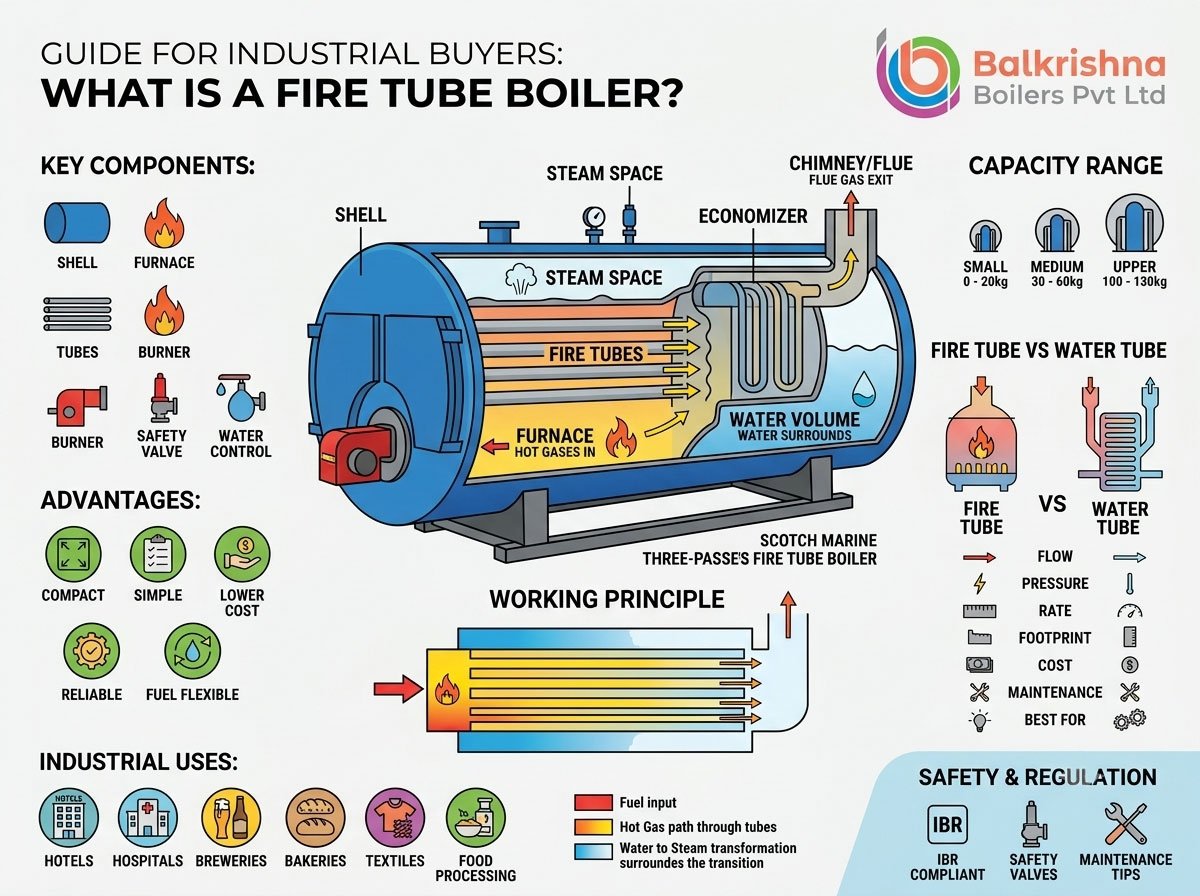
Walk into almost any small or mid-sized factory, hotel boiler room, or hospital utility area in India, and there’s a good chance you’ll find a fire tube boiler quietly doing the work. It is, by a wide margin, the most common boiler design in the country — valued for its simplicity, compact footprint, and lower upfront cost compared to its high-pressure cousin, the water tube boiler.
If you’re evaluating a new steam or hot water system for your plant, understanding what a fire tube boiler is, how it works, and where it fits best will help you make a far more informed purchasing decision. This guide covers exactly that.
What is a Fire Tube Boiler?
A fire tube boiler is a type of boiler in which hot combustion gases pass through a bundle of tubes, while the water to be heated surrounds the outside of those tubes inside a large sealed shell. This is the exact opposite of a water tube boiler, where water flows inside the tubes and hot gases pass around the outside.
Because the entire tube bundle and water volume sit inside one large cylindrical shell, fire tube boilers are also commonly called “shell boilers” or “smoke tube boilers.” They are the design most people picture when they think of a classic industrial boiler — a horizontal steel drum with a burner at one end.
Think of it like brewing tea in a large pot with a heating coil running through it: the coil (tube) carries the heat source, and the water surrounding it in the pot absorbs that heat and eventually boils. That is essentially how a fire tube boiler operates, just at industrial scale and under pressure.
How Does a Fire Tube Boiler Work?
The working principle of a fire tube boiler follows a straightforward, well-proven cycle:
- Fuel is burned in the furnace. Oil, gas, or solid fuel is ignited at one end of the boiler, inside a large combustion chamber (often called the “morrison tube” or furnace tube).
- Hot gases travel through the tube bundle. The combustion gases pass through a series of small-diameter tubes running the length of the shell — often in two, three, or four “passes” to maximize contact time and heat transfer.
- Heat transfers to the surrounding water. As the hot gases move through the tubes, heat is conducted through the tube walls into the water that fills the shell around them.
- Steam collects at the top of the shell. As the surrounding water heats and eventually boils, steam rises and collects in the upper part of the shell, ready to be drawn off through the steam outlet.
- Flue gases exit through the chimney. After giving up most of their heat, the cooled combustion gases exit through the flue and chimney — often after passing through an economizer to recover any remaining waste heat.
Because the entire heating surface is fixed within one large shell, fire tube boilers respond quickly to load changes and are simple for operators to monitor, maintain, and repair — a major reason they remain the default choice for smaller and mid-sized industrial applications.
Key Components of a Fire Tube Boiler
A typical fire tube boiler consists of the following parts:
- Shell: The large cylindrical pressure vessel that holds the bulk of the boiler’s water.
- Furnace/Morrison Tube: The large-diameter tube where fuel combustion actually takes place.
- Fire Tubes (Smoke Tubes): The smaller tubes through which hot combustion gases pass on their way to the flue.
- Burner: Delivers and ignites the fuel — oil, gas, or solid fuel — inside the furnace.
- Economizer: Recovers waste heat from exiting flue gases to pre-heat incoming feedwater.
- Safety Valve: Automatically releases pressure if it exceeds the safe operating limit.
- Water Level Indicator and Low-Water Cut-off: Ensures tubes are never exposed to dry-firing conditions.
- Blowdown Valve: Used to periodically remove sludge and concentrated solids from the shell.
Types of Fire Tube Boilers
Fire tube boilers are generally classified by shell orientation and the number of gas passes:
- Horizontal Return Tubular (HRT) Boilers: One of the earliest designs, with fire tubes running horizontally and gases returning through a second pass.
- Scotch Marine Boilers: A highly compact, multi-pass horizontal design, widely used in packaged industrial and marine boilers today for its efficiency and small footprint.
- Vertical Fire Tube Boilers: Space-saving vertical shell design, common where floor space is limited.
- Two-Pass, Three-Pass, and Four-Pass Boilers: Refers to how many times the flue gases travel the length of the shell before exiting — more passes generally mean better heat recovery and higher efficiency.
Most modern industrial fire tube boilers — including compact, factory-assembled “packaged” units — are built on the three-pass Scotch Marine principle, offering a strong balance of efficiency, reliability, and ease of installation. You can explore packaged options such as our Gas Fired Steam Boiler – 200 Kg to 850 Kg/hr and Oil/Gas Fired Steam Boiler – 500 Kg/hr to 10 TPH, both engineered around this proven fire-tube design.
Fire Tube vs. Water Tube Boiler: What’s the Difference?
| Parameter | Fire Tube Boiler | Water Tube Boiler |
|---|---|---|
| Flow Path | Gases inside tubes, water outside | Water inside tubes, gases outside |
| Pressure Capability | Low to medium (typically up to ~20 TPH) | Very high (used in power plants) |
| Steam Generation Rate | Slower, larger water mass to heat | Faster, due to smaller water volume |
| Footprint | Compact, simpler layout | Generally taller, more complex |
| Capital Cost | Lower for comparable small-to-mid capacity | Higher, but justified at large scale |
| Maintenance | Comparatively easier to inspect and clean | More involved due to tube bank size |
| Best Suited For | Smaller industrial, commercial, and process heating loads | Power generation, large continuous process plants |
If your operation needs moderate pressure, a compact footprint, and lower upfront investment, a fire tube boiler is usually the right fit. For a deeper look at when the reverse design makes more sense, see our companion guide on what a water tube boiler is and how it compares for high-pressure, high-capacity operations.
Advantages of Fire Tube Boilers
- Lower capital cost compared to water tube boilers of similar output.
- Compact, simple construction that’s easy to inspect, clean, and maintain.
- Fast to install: most units arrive as complete, factory-assembled packages requiring minimal on-site assembly.
- Reliable for moderate pressure needs: ideal where steam demand doesn’t require power-plant-level pressure.
- Fuel flexibility: available in oil, gas, and electric-fired configurations to match your existing utility setup.
Limitations to Consider
- Pressure and capacity ceiling: generally not suited beyond roughly 20 TPH or higher-pressure applications.
- Slower response to sudden load changes due to the larger water volume that must heat up.
- Larger water volume means a longer cold-start time compared to water tube designs.
- Water treatment still matters: scale buildup on the outside of the tubes reduces heat transfer efficiency over time, just as it does inside water tube systems.
Industries That Rely on Fire Tube Boilers
Fire tube boilers are the workhorse of operations where steam or hot water demand is moderate, space is limited, and quick installation matters. Common applications include:
- Hotels, resorts, and commercial kitchens, where hot water and cooking steam need to be reliable without a large utility footprint — see our guide on boilers for hotels, resorts, and commercial kitchens.
- Hospitals and healthcare facilities, which depend on dependable steam for sterilization and hot water — read more in boilers for hospitals and healthcare facilities.
- Bakeries and confectionery units, where consistent, moderate-pressure steam drives ovens and proofing chambers — covered in our post on boilers for bakery and confectionery units.
- Breweries and distilleries, where hygiene-focused, moderate-pressure steam systems are essential — see boilers for breweries and distilleries.
- Small and mid-sized textile, food processing, and pharmaceutical units that need dependable steam without the cost or complexity of a power-plant-scale system.
Choosing the Right Fire Tube Boiler for Your Plant
A few factors should guide your decision when selecting a fire tube boiler:
- Peak steam or hot water demand: Total up your connected load and add a 10–15% margin for future expansion.
- Available fuel source: Oil and gas-fired units suit sites with pipeline or tanker access, while electric units suit sites prioritizing zero on-site combustion.
- Space constraints: Vertical fire tube designs are worth considering where floor space is limited.
- Response time needs: If your process involves frequent load swings, discuss multi-pass and automation options with your supplier to minimize lag.
- Water treatment setup: Even though water sits outside the tubes, scale buildup still reduces efficiency — softening and regular blowdown remain essential.
Our Steam Boiler category includes a wide range of fire-tube-style packaged units, alongside our Hot Water Boiler range and Electric Boiler range for sites that prefer electric-fired systems.
At our sister facility, Balkrishna Boilers Pvt Ltd, we manufacture a similarly extensive Steam Boiler product line, including compact models such as STEAMJET and COMCUBE, along with our Hot Water Boiler range and Thermic Fluid Heater range for facilities needing dependable, moderate-pressure thermal systems.
Fire Tube Boiler Capacity Ranges
Fire tube boilers are manufactured across a range of capacities to suit different scales of operation:
- Small Capacity (up to 1 TPH / 1000 kg/hr): Common in hotels, hospitals, bakeries, and small commercial kitchens where steam or hot water demand is modest.
- Medium Capacity (1–10 TPH): Widely used in mid-sized process industries such as textile units, breweries, and food processing plants.
- Upper Capacity (10–20 TPH): Found in larger fire-tube packaged units for process industries that still fall within moderate-pressure requirements.
Beyond this range, most plants transition to a water tube design to accommodate higher pressure and continuous, large-scale steam demand cost-effectively.
Frequently Asked Questions
Is a fire tube boiler cheaper than a water tube boiler? Yes, for comparable small-to-mid capacities, fire tube boilers typically have a lower upfront capital cost due to their simpler, single-shell construction.
What is the maximum pressure a fire tube boiler can handle? Most fire tube boilers operate up to roughly 18–20 kg/cm² and capacities up to about 20 TPH, beyond which a water tube design becomes more practical and cost-effective.
Can a fire tube boiler run on solid fuel? Yes, though oil and gas-fired fire tube boilers are far more common today due to their cleaner combustion and simpler automation compared to solid-fuel-fired variants.
How often does a fire tube boiler need maintenance? Regular blowdown should be performed at least once per shift, with a full internal and external tube inspection scheduled per IBR guidelines, typically annually.
Do fire tube boilers need IBR approval in India? Yes, fire tube boilers exceeding the specified capacity and pressure thresholds must comply with Indian Boiler Regulations (IBR) and undergo certified inspection, just like water tube systems.
Which is better for a small business — fire tube or water tube? For most small and mid-sized businesses with moderate steam needs, a fire tube boiler offers the better balance of cost, footprint, and ease of operation. Large-scale or high-pressure operations should consider a water tube design instead.
Conclusion
A fire tube boiler remains one of the most trusted, cost-effective ways to generate steam or hot water for small and mid-sized industrial, commercial, and institutional facilities across India. Its simple construction, compact footprint, and quick installation make it the practical choice wherever pressure and capacity requirements stay within its proven operating range.
If you’re weighing a fire tube system against a higher-capacity water tube design, our engineering teams at Indian Boilers and Balkrishna Boilers can help you make the right call for your specific process. Get a custom quote today or reach out to our team at balkrishn.com for a detailed technical consultation.