
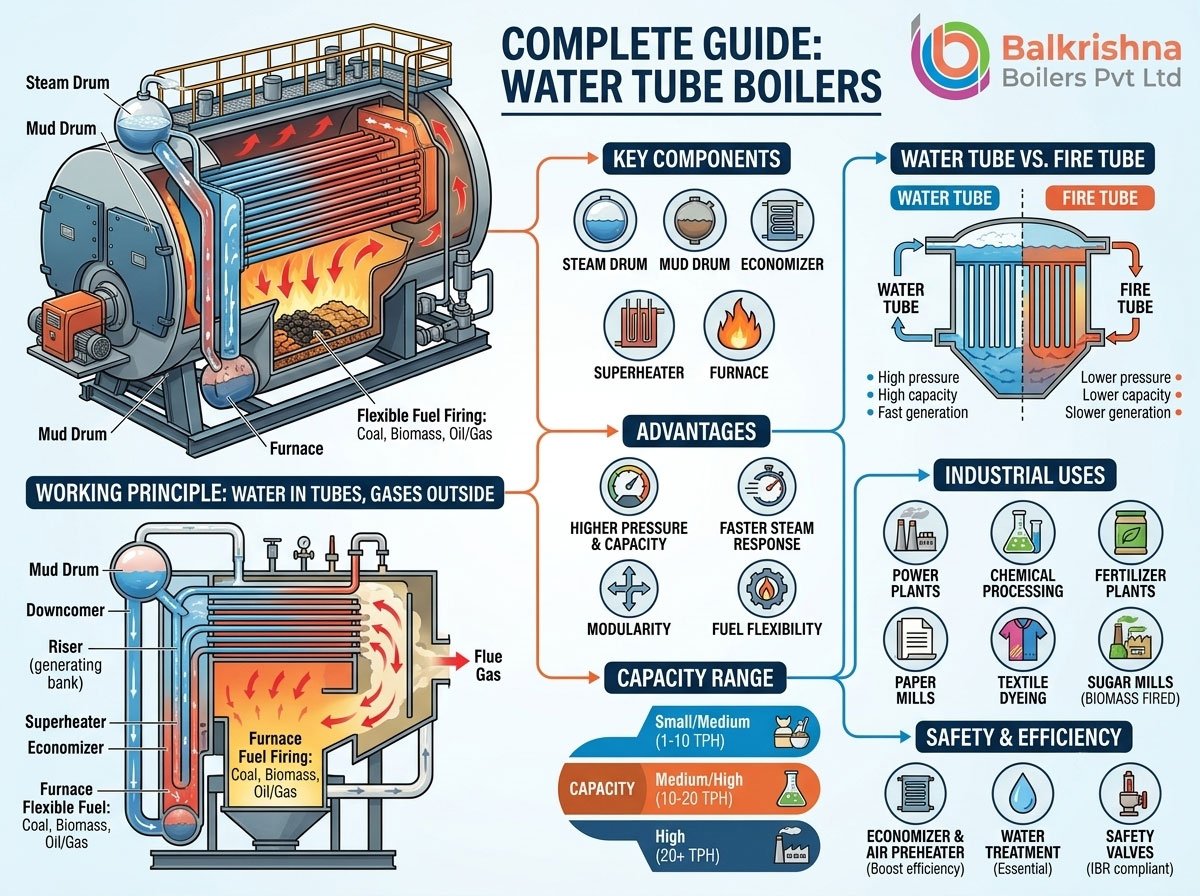
If you have ever compared quotations for an industrial steam system, you have almost certainly come across the term “water tube boiler.” It is one of the two fundamental boiler designs used across power plants, process industries, and heavy manufacturing — the other being the fire tube boiler. But what exactly separates a water tube boiler from the rest, and why do so many high-pressure, high-capacity plants insist on this design?
In this guide, we break down what a water tube boiler is, how it works, its construction, its advantages and limitations, and the industries that depend on it every day.
What is a Water Tube Boiler?
A water tube boiler is a type of steam-generating boiler in which water flows inside a network of tubes, while hot combustion gases from burning fuel circulate around the outside of those tubes. This is the exact reverse of a fire tube boiler, where hot gases travel through tubes that are submerged in a large body of water.
Because the water is confined to smaller-diameter tubes rather than one large shell, a water tube boiler can safely handle far higher pressures and generate steam much faster than a comparable fire tube unit. This is why water tube designs are the standard choice for power generation, heavy chemical processing, and any operation demanding continuous, high-pressure steam.
You can think of it this way: a fire tube boiler is like heating water in a kettle by running a flame through a coil inside it. A water tube boiler flips that idea — the water itself runs through the coil, while the flame and hot gases surround it from the outside.
How Does a Water Tube Boiler Work?
The working principle of a water tube boiler follows a continuous cycle:
- Feedwater enters the system. Treated feedwater is pumped into a drum, typically called the mud drum or lower drum, at the base of the boiler.
- Water rises through the tubes. As fuel is burned in the furnace, the surrounding tubes absorb intense heat, and the water inside them begins to heat up and rise naturally through convection — a phenomenon known as natural circulation. In high-pressure designs, pumps may assist this movement (forced circulation).
- Steam separates in the steam drum. The heated water and steam mixture reaches the upper steam drum, where steam is separated from the remaining water. The water is recirculated back down through the “downcomer” tubes to repeat the cycle.
- Steam is superheated (if required). For power generation and certain industrial processes, the saturated steam passes through a superheater, raising its temperature further before it is sent to the turbine or process line.
- Flue gases exit through the economizer and stack. Before leaving the boiler, hot flue gases often pass through an economizer, which pre-heats incoming feedwater using waste heat, significantly improving overall efficiency.
This constant circulation of water through tubes exposed to intense heat is what allows water tube boilers to reach pressures well beyond what a fire tube shell could safely contain.
Key Components of a Water Tube Boiler
A typical water tube boiler consists of the following parts:
- Steam Drum: Where steam is separated from water at the top of the boiler.
- Mud Drum (Water Drum): Located at the bottom, it collects sediment and feeds water into the tube bank.
- Riser and Downcomer Tubes: Riser tubes carry the heated water-steam mixture upward; downcomer tubes return cooler water back down.
- Furnace/Combustion Chamber: Where fuel — coal, biomass, agro-waste, oil, or gas — is burned to generate heat.
- Superheater: Increases steam temperature beyond saturation point for turbine or high-temperature process use.
- Economizer: Recovers waste heat from flue gases to pre-heat feedwater.
- Air Preheater (APH): Uses flue gas heat to warm incoming combustion air, further boosting efficiency.
- Safety Valves and Water Level Controls: Mounted per IBR (Indian Boiler Regulations) norms to prevent overpressure and dry-firing.
Types of Water Tube Boilers
Water tube boilers are generally classified based on tube arrangement and circulation method:
- Straight Tube Boilers: Tubes are arranged in straight rows connecting header boxes; simple in design and easy to clean.
- Bent Tube (Stirling-type) Boilers: Curved tube arrangements connect multiple drums, allowing more compact, high-capacity designs — common in large power plants.
- Chain Grate / Travelling Grate Water Tube Boilers: Widely used for solid and agro-fuel firing, where fuel moves continuously across a grate under a water-tube bank. This is the design behind many biomass and husk-fired systems.
- Fluidized Bed Combustion (FBC) Water Tube Boilers: Fuel is burned in a bed of suspended, fluidized particles for cleaner, more efficient combustion of solid fuels — a good example is a Water Wall Membrane Panel FBC Steam Boiler, where the furnace walls themselves are built from water tubes.
- High-Pressure Industrial Water Tube Boilers: Purpose-built for heavy-duty plants requiring continuous, high-pressure steam, such as this High Pressure Industrial Steam Boiler – 750 Kg/hr.
Water Tube vs. Fire Tube Boiler: What’s the Difference?
| Parameter | Water Tube Boiler | Fire Tube Boiler |
|---|---|---|
| Flow Path | Water inside tubes, gases outside | Gases inside tubes, water outside |
| Pressure Capability | Very high (used in power plants) | Low to medium |
| Steam Generation Rate | Fast, due to smaller water volume | Slower, larger water mass to heat |
| Footprint | Generally taller, more complex | Compact, simpler layout |
| Maintenance | More involved due to tube bank size | Comparatively easier to inspect |
| Best Suited For | Power generation, large process plants | Smaller industrial and commercial units |
If your plant requires very high pressure, rapid steam response, or large-scale continuous operation, a water tube design is usually the better fit. For smaller heating loads or lower-pressure requirements, a fire tube boiler may be more economical. Our team can help you evaluate this trade-off in detail when you get in touch with our engineers.
Advantages of Water Tube Boilers
- Higher pressure and capacity: Ideal for power generation and heavy industrial demand.
- Faster steam generation: Smaller water volume per tube means quicker response to load changes.
- Better safety profile at high pressure: Failure of a single tube is far less catastrophic than a shell failure in a fire tube design.
- Flexible fuel firing: Compatible with coal, biomass, agro-waste, oil, gas, and multi-fuel setups.
- Scalable design: Capacity can be increased by adding more tube banks without redesigning the entire unit.
Limitations to Consider
- Higher capital cost compared to fire tube boilers of similar capacity.
- Water treatment is critical — because tubes are narrow, scale formation can quickly restrict flow and cause overheating.
- More complex maintenance, requiring skilled operators and regular inspection of tube banks.
- Larger physical footprint in bent-tube and multi-drum configurations.
Industries That Rely on Water Tube Boilers
Water tube boilers are the backbone of operations where steam demand is large, continuous, and high-pressure. Common applications include:
- Power generation plants, where steam drives turbines to produce electricity.
- Chemical and petrochemical processing, including solvent and chemical recovery plants.
- Fertilizer manufacturing, which depends on stable high-pressure steam for production — read more in our guide on boilers for the fertilizer industry.
- Cement and construction material plants, where thermal demand is intense and continuous — see our detailed breakdown of boilers for cement and construction material plants.
- Large textile dyeing and paper mills, running around the clock at high capacity.
- Sugar mills and large agro-processing units, often firing agro-waste such as bagasse or husk through chain-grate or travelling-grate water tube systems, similar to our Agro Waste Fired Steam Boiler – 5 to 20 TPH.
Choosing the Right Water Tube Boiler for Your Plant
Selecting a water tube boiler isn’t just about picking the highest capacity model. A few factors should guide your decision:
- Peak steam demand: Add up the requirements of all connected machinery, then build in a safety margin of roughly 10–15% for future expansion.
- Operating pressure: Confirm your process requires the elevated pressures a water tube design offers — over-specifying adds unnecessary cost.
- Fuel availability: Biomass and agro-waste-fired systems suit plants near a steady raw material supply, while oil and gas-fired systems suit plants with pipeline or tanker access.
- Water quality and treatment setup: Since tube-side scaling is a real risk, ensure your plant has adequate softening or demineralization capability.
- Automation level: PLC-based controls reduce manual monitoring and improve response time to load changes.
Our range of steam boilers, including high-capacity and water-tube-style models under the Steam Boiler category, is engineered to match these exact requirements — from agro-waste and biomass-fired chain-grate systems to high-pressure industrial units. You can also browse our broader Industrial Boiler range for heavy-duty configurations.
At our sister facility, Balkrishna Boilers Pvt Ltd, we manufacture a similarly extensive Steam Boiler product line, including high-capacity models such as COMBIPOWER, STEAMPOWER, and VEPOMAX, built for plants that need dependable, high-pressure steam around the clock.
Safety and Efficiency Considerations
Because water tube boilers often operate at very high pressures, safety systems are built into every stage of the design. Spring-loaded safety valves release excess pressure automatically, while low-water level alarms and flame failure detectors shut down the fuel supply the moment an unsafe condition is detected. Redundant water level indicators are standard on most industrial units, ensuring operators always have a clear, real-time view of drum levels.
Efficiency, meanwhile, is driven largely by how well waste heat is recovered. An economizer alone can improve fuel efficiency noticeably by using flue gas heat to pre-warm incoming feedwater, while an air preheater captures additional heat to warm combustion air before it even reaches the furnace. Combined, these two components can meaningfully reduce fuel consumption over the life of the boiler, which is why most modern water tube systems are supplied with both as standard rather than optional add-ons.
Water treatment deserves special mention here. Because water tube boilers push water through relatively narrow-bore tubing at high velocity, even a thin layer of scale can restrict flow dramatically, leading to localized overheating and, in severe cases, tube rupture. A properly sized softening or demineralization plant, combined with regular blowdown, is not an optional extra — it is essential to protecting the investment and keeping the boiler running at its rated efficiency for its full service life.
Water Tube Boiler Capacity Ranges
Water tube boilers are manufactured across a wide capacity spectrum to suit different scales of operation:
- Small to Medium Capacity (1–10 TPH): Common in mid-sized process industries such as food processing, textile dyeing units, and rice mills, often fired with agro-waste or biomass.
- Medium to High Capacity (10–20 TPH): Suited to larger chemical plants, fertilizer units, and pharmaceutical manufacturing where steam demand is continuous and substantial.
- High Capacity (20 TPH and above): Typically deployed in power generation, large cement plants, and heavy process industries with round-the-clock operation.
Matching the right capacity band to your actual peak demand — rather than simply choosing the largest available unit — has a direct impact on fuel efficiency, capital cost, and long-term operating economics.
Frequently Asked Questions
Is a water tube boiler more efficient than a fire tube boiler? Water tube boilers generally achieve higher thermal efficiency at high pressures because of faster heat transfer and lower water volume, especially when paired with an economizer and air preheater.
What pressure can a water tube boiler handle? Modern water tube boilers can operate well beyond 100 kg/cm², making them suitable for power plants and heavy process industries, whereas fire tube boilers are typically limited to low-to-medium pressure ranges.
Can a water tube boiler run on biomass or agro-waste? Yes. Chain-grate and travelling-grate water tube boilers are widely used with biomass, husk, and agro-waste fuels, offering a cost-effective and renewable steam solution for process industries.
How often should a water tube boiler undergo maintenance? Tube banks should be inspected regularly for scale buildup and soot deposits, with blowdown performed at least once per shift and a full internal inspection scheduled annually or per IBR guidelines.
Do water tube boilers need IBR approval in India? Yes, water tube boilers operating above the specified pressure and capacity thresholds must comply with Indian Boiler Regulations (IBR) and undergo certified inspection.
Conclusion
A water tube boiler remains the design of choice wherever a plant needs high pressure, rapid steam generation, and long-term reliability. From power stations to fertilizer plants, cement units, and large agro-processing facilities, this design continues to prove why it has been the industry standard for over a century.
Whether you’re evaluating a new installation or upgrading an ageing system, our engineering teams at Indian Boilers and Balkrishna Boilers can help you select the right water tube configuration for your process. Get a custom quote today or reach out to our team at balkrishn.com for a detailed technical consultation.