
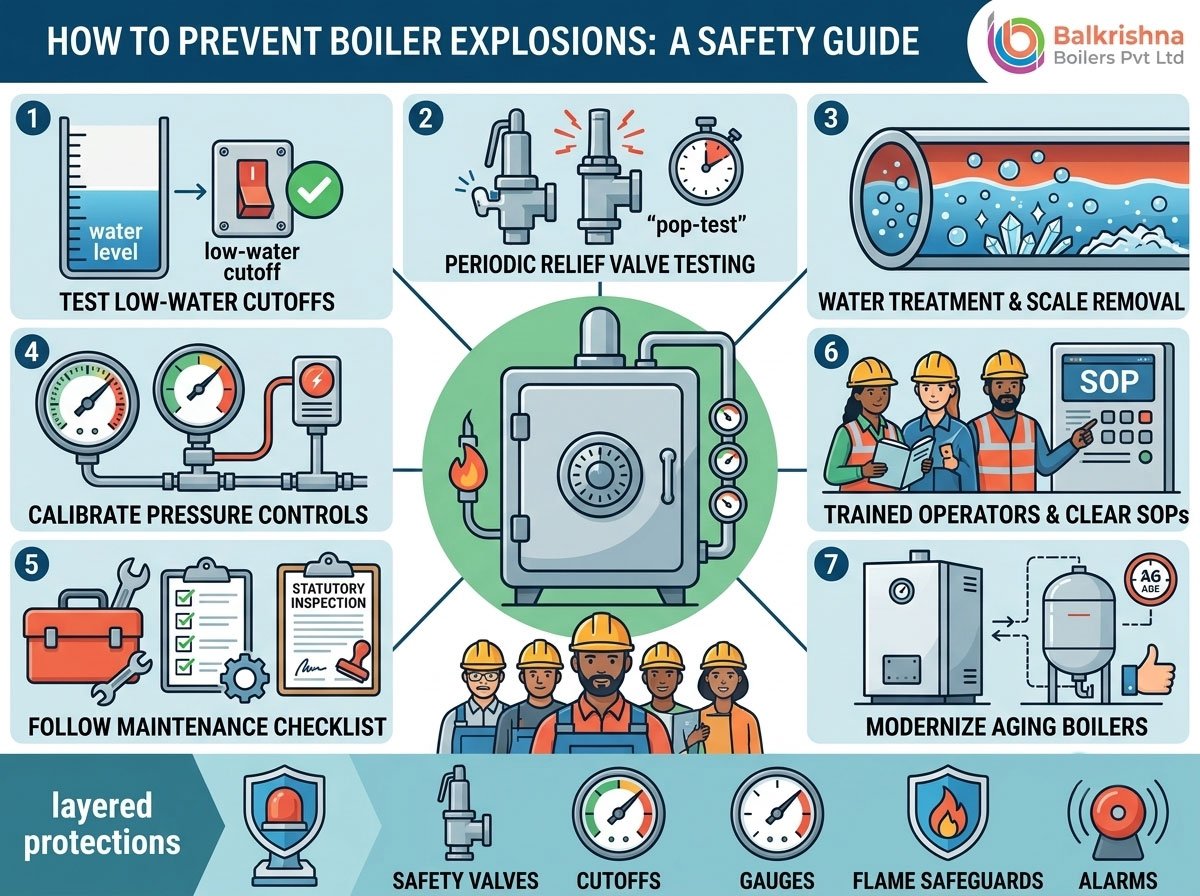
A boiler explosion is one of the few industrial accidents that can shut down a plant, injure workers, and destroy a facility in a matter of seconds. Yet in almost every documented case, the failure did not begin as an explosion — it began weeks or months earlier as a skipped inspection, an ignored gauge reading, or a safety valve nobody had tested in years. Understanding how these accidents actually develop is the first step to making sure your plant never becomes a case study.
This guide walks through why boiler explosions happen, the warning signs operators routinely miss, and the maintenance, training, and equipment choices that keep a boiler room safe year after year.
Why This Topic Matters for Every Plant, Not Just Boiler Rooms
Steam and thermal systems sit at the center of production in textiles, pharmaceuticals, food processing, chemicals, and dozens of other industries. A pressure vessel failure doesn’t just damage the boiler — it can rupture nearby piping, injure operators, and halt an entire production line. Whether you run a steam boiler, an electric boiler, or a thermic fluid heater, the underlying safety principles are the same: control pressure, control water level, and never let maintenance slip.
The Physics Behind a Boiler Explosion
A boiler stores enormous thermal energy in pressurized water or steam. When that pressure exceeds what the vessel can safely contain — or when water suddenly flashes into steam inside an overheated, near-empty shell — the stored energy releases almost instantly. This is why boiler failures are so much more violent than an ordinary equipment breakdown: the vessel isn’t just failing, it’s releasing energy that took hours to build up, all at once.
There are two broad failure patterns plant engineers should understand:
- Overpressure explosion — pressure builds beyond the vessel’s rated limit because relief devices fail to open or are undersized/blocked.
- Low-water explosion — the water level drops below the heating surface, the metal overheats, and the moment water re-contacts the superheated metal (or the weakened shell finally gives way under normal pressure), a violent steam-flash failure occurs. Low-water incidents are widely considered the single most common cause of catastrophic boiler failures.
Top Causes of Boiler Explosions
1. Low Water Conditions and Low-Water Cutoff Failure
This is the leading cause of serious boiler accidents worldwide. If the feedwater system fails, a valve is mistakenly left closed, or the low-water cutoff switch is fouled with scale and doesn’t trip, the boiler continues firing against an empty or near-empty shell. The metal overheats within minutes, and failure can follow immediately after.
Prevention: Test low-water cutoff devices on a fixed schedule (many plants do this weekly), keep a secondary/backup cutoff in the circuit, and never bypass a safety interlock to “keep production running.”
2. Safety Valve and Pressure Relief Valve Failure
Safety valves are the last line of defense against overpressure. If they’re undersized, corroded shut, improperly set, or simply never tested, they will not lift when the boiler needs them to.
Prevention: Pop-test relief valves at the interval specified by the manufacturer and by the Indian Boilers Act, replace valves that show signs of seat leakage or corrosion, and never adjust a safety valve setting without a qualified inspector’s sign-off.
3. Poor Water Treatment, Scale, and Corrosion
Untreated feedwater deposits scale on heating surfaces. Scale acts as an insulator — the metal behind it can’t shed heat into the water fast enough, so it overheats and weakens even while the boiler appears to be running normally. Corrosion from improperly treated water thins the pressure shell from the inside, reducing its safe working pressure over time without any visible external sign.
Prevention: Maintain a proper water treatment program (softening, deaeration, chemical dosing), monitor TDS and conduct regular blowdown, and schedule internal inspections that specifically check for scale buildup and pitting.
4. Over-Pressurization From Control Failures
Faulty pressure controls, stuck modulating valves, or a burner that continues firing after the setpoint is reached can push a boiler past its rated pressure even with functioning gauges, if nobody is watching them.
Prevention: Calibrate pressure controls and gauges on schedule, and use boilers with redundant high-pressure cutouts rather than a single control loop.
5. Inadequate Maintenance and Deferred Inspections
Most catastrophic failures are not sudden — they’re the endpoint of months of deferred maintenance. A worn gasket, a slowly failing gauge, or a missed statutory inspection rarely causes an accident by itself, but together they remove every layer of protection the system was designed with.
Prevention: Follow a documented daily/weekly/monthly/annual maintenance schedule (see checklist below) and never let a statutory inspection lapse to avoid production downtime.
6. Operator Error and Inadequate Training
A boiler is only as safe as the person operating it. Bypassing an alarm, misreading a gauge, or not understanding start-up/shutdown sequencing has caused some of the worst industrial boiler accidents on record.
Prevention: Formal operator training and refresher courses, clear written SOPs posted in the boiler room, and a strict no-bypass policy on safety interlocks — enforced at the management level, not left to individual judgment.
7. Aging Equipment and Material Fatigue
Pressure vessels have a finite service life. Repeated thermal cycling, years of minor corrosion, and outdated safety-device designs all reduce the margin of safety in older boilers, even ones that have never shown an obvious problem.
Prevention: Track total operating hours and vessel age against manufacturer guidance, and treat a boiler replacement or major overhaul as a safety investment rather than a deferred capital expense.
Essential Safety Systems Every Boiler Should Have
A safe boiler room is built on layered protection, so that if one safeguard fails, another catches it:
- ASME/IBR-rated safety and pressure relief valves, correctly sized for the vessel
- Primary and backup low-water cutoff devices
- Calibrated pressure gauges and high-pressure limit switches
- Flame safeguard/combustion safety controls that prevent fuel buildup
- Automatic blowdown systems to manage water quality
- Audible and visual alarms for abnormal conditions
Modern boiler designs build several of these protections in as standard rather than optional add-ons. When you’re evaluating equipment, it’s worth comparing how different boiler types handle these safeguards — our guides on what a fire tube boiler is and what a water tube boiler is explain how each design responds differently to low-water conditions and pressure spikes, which is a useful starting point before you specify a new unit.
A Practical Preventive Maintenance Checklist
Daily
- Log water level, pressure, and temperature readings
- Visually inspect for leaks, unusual noise, or vibration
- Confirm burner flame is stable and normal in color
Weekly
- Test low-water cutoff by manual trip
- Check blowdown valves and perform scheduled blowdown
- Inspect gauge glass and water column for scale or fouling
Monthly
- Test all alarms and safety interlocks
- Inspect safety/relief valves for leakage
- Review water treatment chemical dosing against lab results
Annually (or per statutory requirement)
- Full internal and external inspection by a certified inspector
- Hydrostatic testing where mandated
- Complete servicing of burner, controls, and safety valves
- Renewal of statutory boiler certification under the Indian Boilers Act
Keeping this schedule as a signed, dated log — not just a mental habit — is what regulators and insurers will ask to see after any incident, and it’s the single easiest way to catch a developing problem before it becomes a failure.
Statutory Compliance in India
Boiler safety in India isn’t just good practice — it’s law. The Indian Boilers Act and the associated Boiler Regulations require periodic inspection and certification by a competent authority, proper documentation of repairs and modifications, and adherence to design codes for any new installation. Treating statutory inspection as a formality rather than a genuine safety check is one of the most common — and most dangerous — mistakes plants make. Manufacturing and installing boilers that meet these design and safety codes from day one removes a major source of long-term risk.
Choosing the Right Boiler Reduces Long-Term Risk
Explosion risk isn’t only about maintenance — it starts with specifying the right boiler for your process, fuel, and pressure requirements. An undersized or mismatched boiler is often pushed harder than it should be, accelerating wear on exactly the components that matter most for safety.
At Balkrishna Boilers, our steam boiler range — including models like STEAMGEN, STEAMPOWER, and COMBIPOWER — is engineered with certified safety valves, redundant water-level controls, and IBR-compliant construction as standard. If your process runs on thermal fluid rather than steam, our thermic fluid heater range is designed to operate at low pressure while still delivering high-temperature heat, which is itself an inherent safety advantage for many applications. For lower-risk, cleaner installations, our electric boiler range eliminates combustion-related hazards entirely.
You can explore the complete lineup — Steam Boiler, Electric Boiler, Thermic Fluid Heater, Hot Water Boiler, and Hot Air Generator — to see which configuration fits your plant’s safety and process requirements.
What to Do in a Boiler Emergency
Even with strong preventive practices, every plant should have a written emergency response plan:
- Train operators to recognize early warning signs — unusual noise, rapid pressure rise, low water alarms — and to shut down immediately rather than “wait and see.”
- Post emergency shutdown procedures visibly in the boiler room, not just in a manual.
- Establish a clear evacuation zone and drill it periodically.
- Report every near-miss, not just actual failures — near-misses are the earliest warning a system gives before a real accident.
Building a Culture of Boiler Safety
The plants that never have a boiler accident share one thing in common: safety isn’t treated as a checklist item, it’s treated as an ongoing discipline. That means investing in properly engineered equipment, maintaining it on schedule without exception, training operators thoroughly, and never allowing production pressure to override a safety concern.
If you’re evaluating a new boiler, upgrading safety controls, or simply want a professional assessment of your current system’s risk profile, our team can help. Explore our full product range or get in touch with our engineers for a safety-focused consultation — you can also reach the Balkrishna Boilers team directly through our contact page.