
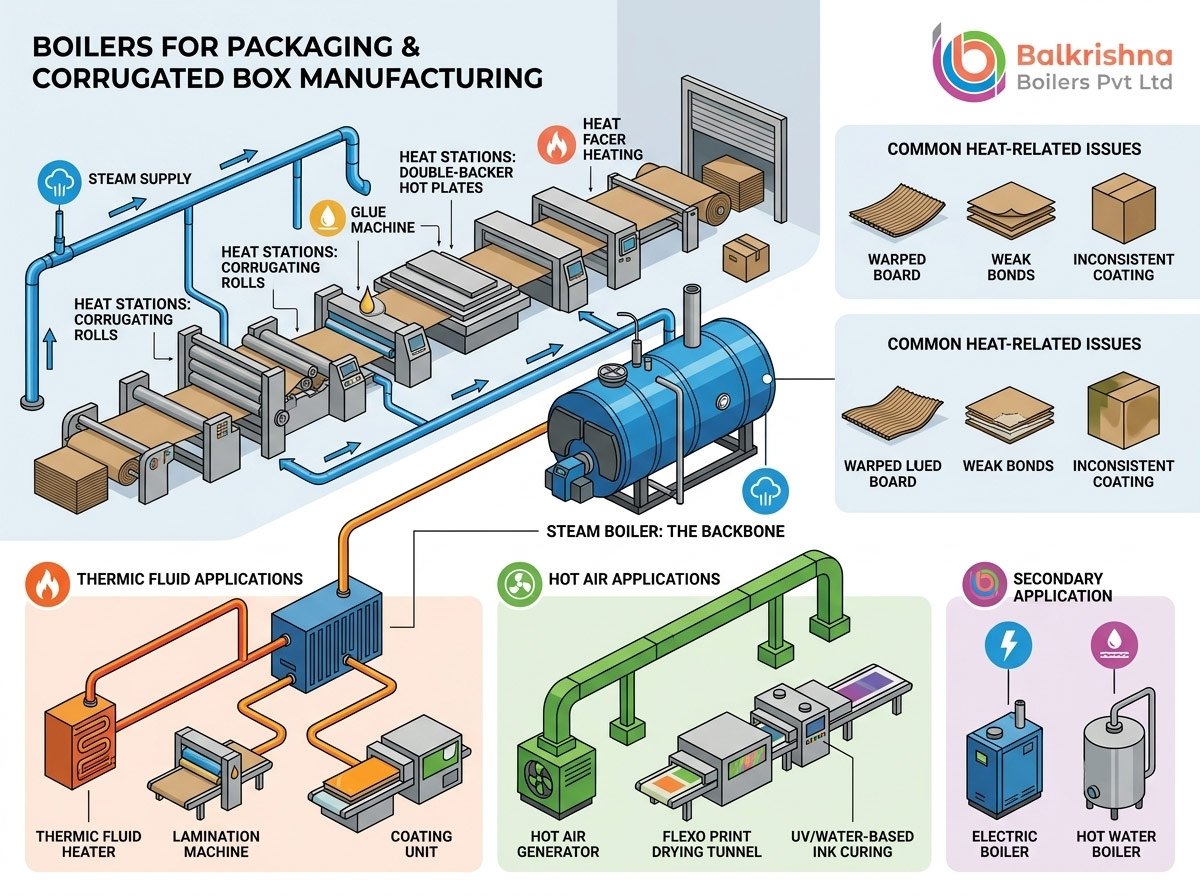
India’s packaging industry runs on two things: paper and heat. Behind every corrugated carton stacked at an e-commerce warehouse, every laminated mono-carton on a pharmacy shelf, and every printed shipper leaving a Food and Beverage plant, there is a corrugator, a laminator, or a pasting line drawing steam or hot air from a boiler room that most customers never see. Get that heat wrong — too little, too wet, too inconsistent — and the result is warped board, weak bonds, blocked flutes, and rejected pallets. Get it right, and a packaging plant can run three shifts without a single quality complaint tracing back to the corrugator.
This guide looks at where heat is actually used across a packaging and corrugated box facility, which boiler or heater fits which stage, and how manufacturers size and select equipment that keeps a corrugation line moving instead of waiting on steam pressure.
Why Packaging and Corrugated Box Plants Depend So Heavily on Heat
A corrugated box does not start life as a box. It starts as three, five, or seven layers of kraft paper that need to be shaped, glued, dried, and bonded into a single rigid board before it is ever slotted, printed, or die-cut. Every one of those steps is a heat transfer problem:
- Fluting the medium paper requires steam-heated corrugating rolls hot enough to soften the paper’s lignin and hemicellulose so it can be shaped into flutes without cracking.
- Bonding the flutes to the linerboard needs starch adhesive that gelatinizes only within a narrow temperature band — too cool and the bond never sets, too hot and the paper scorches.
- Drying the single-face and double-backer sections on the corrugator has to happen fast enough to keep line speed up without pulling so much moisture out that the board warps or curls.
- Lamination and pasting for duplex board, mono-cartons, and printed liners depend on either steam-heated platens or thermic fluid-heated rollers to activate adhesive evenly across the sheet width.
- Printing and coating units, especially flexo and offset lines with water-based or UV-cured inks, often need hot air for fast, even drying between colour stations.
Because these stages happen in sequence on a single production line, an undersized or poorly regulated heat source does not just slow one machine — it throttles the entire plant’s output. This is why packaging manufacturers increasingly work with a single heating partner across steam, thermic fluid, and hot air rather than piecing together mismatched equipment stage by stage.
Steam Boilers: The Backbone of the Corrugator
For most corrugated box plants, a steam boiler is still the primary heat source, and for good reason. Steam delivers latent heat efficiently through the corrugating rolls, the single-facer, the glue machine, and the double-backer hot plates, all from one central boiler house piped out to multiple stations.
What packaging plants typically look for in a corrugator-duty steam boiler:
- Fast steam-up and quick load response. Corrugator lines start and stop with order changes, shift breaks, and board-grade transitions. A boiler that takes too long to build pressure back up after a dip creates bottlenecks at the wet end.
- Stable pressure under swinging demand. The single-facer and double-backer sections pull steam unevenly as line speed and paper GSM change, so pressure stability matters more here than in a constant-load process.
- Multi-fuel flexibility. Many packaging units run husk, wood chips, briquettes, or agro-waste to control fuel cost, while others prefer piped natural gas or LPG for cleaner, more consistent combustion near print and food-grade packaging lines.
Balkrishna Boilers’ Steam Boiler range covers this spread — from compact, quick-response models like STEAMJET and STEAMAX for smaller corrugation units, to higher-capacity solid-fuel systems such as HUSKPOWER and PELLETAX for plants running on agricultural residue, and gas or oil-fired options like STEAMPOWER and WILLSTEAM where consistent, low-particulate steam is the priority. For larger integrated plants running multiple corrugators or combining box manufacturing with printing and lamination under one roof, models in the COMBIPOWER and ENERPOWER series are built for continuous, higher-tonnage steam demand.
Thermic Fluid Heaters for Lamination and Duplex Board Work
Not every heat-intensive step in a packaging plant needs steam. Lamination lines, duplex board coating, and pasting sections that run hot rollers or heated platens often perform better on thermic fluid, which holds a stable temperature at low pressure and avoids the scaling and water treatment overhead that comes with steam circuits.
A thermic fluid heater is particularly suited to:
- Duplex and triplex board lamination where roller temperature needs to stay within a tight band across long runs
- Mono-carton and printed liner pasting, where uneven heat shows up immediately as visible bond lines
- Plants that already use thermic fluid elsewhere (die-cutting, print drying) and want one closed-loop system instead of running parallel steam and oil circuits
Balkrishna Boilers offers this under its Thermic Fluid Heater line, including compact models like THERMPAC and DELTAPAC, solid-fuel options such as PELLEPAC, and the vertical-configuration VTF SERIES and VTM SERIES for plants working with a limited boiler-house footprint — a common constraint in packaging units that have expanded their corrugator capacity without expanding the utility yard.
Hot Air Generators for Drying, Printing, and Coating Lines
Where the process needs direct, fast-moving heat rather than heat transferred through a roller or coil — think flexo print drying, UV/water-based ink curing tunnels, or board pre-heating before the corrugator — a hot air generator is usually the more efficient choice. Direct hot air avoids the lag of heating a fluid medium first, which matters on high-speed printing and coating lines where colour-to-colour drying time directly limits press speed.
Balkrishna Boilers’ Hot Air Generator series — including AIRPAC, AIRFORCE, AIRJET, and AIRMAX — is used across corrugated box and carton plants for exactly this: fast, controllable drying without the standby losses of keeping a full steam or thermic fluid circuit running just for one drying tunnel.
Hot Water Boilers for Support Utilities
Packaging plants are not purely a heat-and-dry operation — most also run glue kitchens, cleaning-in-place for adhesive tanks, and staff amenities that need a reliable hot water supply separate from the process steam line. A dedicated hot water boiler, such as the AQUAJET or AQUAMAX from Balkrishna Boilers, keeps these utility loads off the main steam boiler, which protects corrugator uptime during shift changes and cleaning cycles when hot water demand spikes.
Electric Boilers for Small-Batch and Specialty Packaging Units
Not every packaging operation runs at corrugator scale. Specialty box units, sample and prototype lines, and smaller carton converters sometimes need heat only intermittently, or operate in locations where solid fuel storage and combustion emissions are impractical. For these cases, an electric boiler — such as ELECTROPAC or ELECTROMAX — offers instant-on heat with no fuel handling, flue gas treatment, or standby losses, which suits plants where heat demand is occasional rather than continuous.
Sizing Heat Systems to Corrugator Line Speed
The single biggest sizing mistake in packaging-plant boiler selection is matching capacity to average demand instead of peak demand at full line speed. A corrugator running at 150–200 metres per minute on heavier board pulls steam very differently than the same line running light single-wall board at reduced speed, and a boiler sized for the average of the two will bottleneck the moment the plant runs its highest-volume order.
Before finalising equipment, packaging manufacturers should account for:
- Maximum line speed and board GSM range the corrugator is rated for, not just the current typical run
- Number of simultaneous heat-consuming stations — single-facer, double-backer, and any downstream laminator or pasting line drawing from the same header
- Fuel availability and consistency, especially for plants relying on agro-waste where calorific value can vary by season and supplier
- Planned capacity expansion — a second corrugator or an added lamination line is common within a few years of the first, and header and boiler-house layout should leave room for it
Balkrishna Boilers’ technical team works through this sizing exercise directly with packaging and corrugated box manufacturers, reviewing line speed, board specification, and fuel plans before recommending a configuration, rather than sizing on paper capacity alone.
Common Heat-Related Problems on the Corrugator — and What Usually Causes Them
Most quality complaints that trace back to the boiler house show up as physical defects on the finished board long before anyone checks steam logs. Recognising the pattern early saves a lot of guesswork:
- Warping and curling board. Almost always a moisture imbalance — either the single-facer or double-backer section is running with inconsistent steam pressure, drying one side of the board faster than the other. This points to pressure regulation at the boiler, not the corrugator itself.
- Weak or “starved” flute bonds. Usually means the corrugating rolls or glue machine platen never reached the starch gelatinization temperature consistently, which happens when boiler pressure sags under peak multi-station demand.
- Scorched liner or medium. The opposite problem — localised overheating, often from an oversized boiler running at high pressure to compensate for poor distribution, rather than a genuine capacity shortfall.
- Inconsistent lamination bond strength across sheet width. Common on plants running thermic fluid through worn or scaled circuits, where flow — and therefore roller temperature — is no longer even edge to edge.
- Slow colour-to-colour drying limiting press speed. Typically a hot air capacity or distribution issue on the print/coating line rather than anything upstream at the corrugator.
Tracing defects back to their heat source this way, rather than adjusting corrugator settings alone, is often what separates a plant that fixes a quality issue permanently from one that keeps chasing it shift after shift.
Fuel Choice and Running Cost in Packaging Plants
Fuel selection in a corrugated box or packaging unit is rarely just about the lowest per-unit fuel cost. A few practical factors tend to decide it:
- Proximity to agricultural residue markets. Plants located near paper mill clusters or agro-processing belts often find husk, briquettes, or biomass pellets significantly cheaper than piped gas, provided the boiler is designed for consistent combustion across variable-quality solid fuel.
- Emission and locality norms. Units operating in urban or semi-urban industrial estates, or supplying to export and pharma-linked packaging customers with stricter compliance expectations, frequently prefer gas or oil-fired systems for cleaner, more predictable combustion.
- Load profile. Plants running near-continuous three-shift corrugation generally get better lifetime economics from a solid-fuel steam boiler sized for base load, while units with intermittent or seasonal demand often do better with gas-fired or electric systems that avoid fuel storage and standby losses.
Because these trade-offs are specific to each plant’s location, order pattern, and compliance requirements, they’re best worked through directly with the equipment supplier rather than decided from a generic fuel comparison chart.
Frequently Asked Questions
Which boiler is best for a new corrugated box plant? For most corrugators, a steam boiler sized to peak line speed and board GSM is the primary requirement, typically supplemented with a thermic fluid heater or hot air generator if the plant also runs lamination, pasting, or print-drying stages.
Can one boiler run the corrugator, laminator, and print dryer together? It’s possible with careful header design and adequate capacity, but many plants find it more efficient — and easier to troubleshoot — to separate steam for the corrugator from thermic fluid or hot air used on lamination and drying stages.
How often should a packaging plant review its boiler capacity? Any time line speed, board specification, or the number of downstream stations changes — most commonly when a second corrugator, laminator, or printing line is added to an existing facility.
Related Reading
Packaging is one of many process industries where heat quality and consistency directly determine product quality. For a closer look at how similar principles apply in other fibre and heavy-manufacturing sectors, see Boilers for Cotton Ginning and Spinning Mills, where paper-thin moisture tolerances play a similar role, and Boilers for Cement and Construction Material Plants for a look at continuous high-tonnage heat demand. You can browse the full range of use cases on our Industries page, or explore more sector guides on the Indian Boilers blog.
Choosing the Right Partner for Your Packaging Plant
Heat is not a single-equipment decision in a packaging or corrugated box facility — it is a system spanning steam for the corrugator, thermic fluid or hot air for lamination and drying, and hot water for support utilities, all sized against a line speed that keeps changing as the plant grows. Balkrishna Boilers Pvt Ltd has supplied steam boilers, thermic fluid heaters, hot air generators, and hot water systems to packaging manufacturers across India and overseas, engineered around actual corrugator and laminator specifications rather than generic capacity charts.
To discuss the right configuration for your corrugation or packaging line, explore the complete product range or get in touch with our team for a sizing consultation. You can also reach us directly through Indian Boilers.com for product guidance and quotations.