
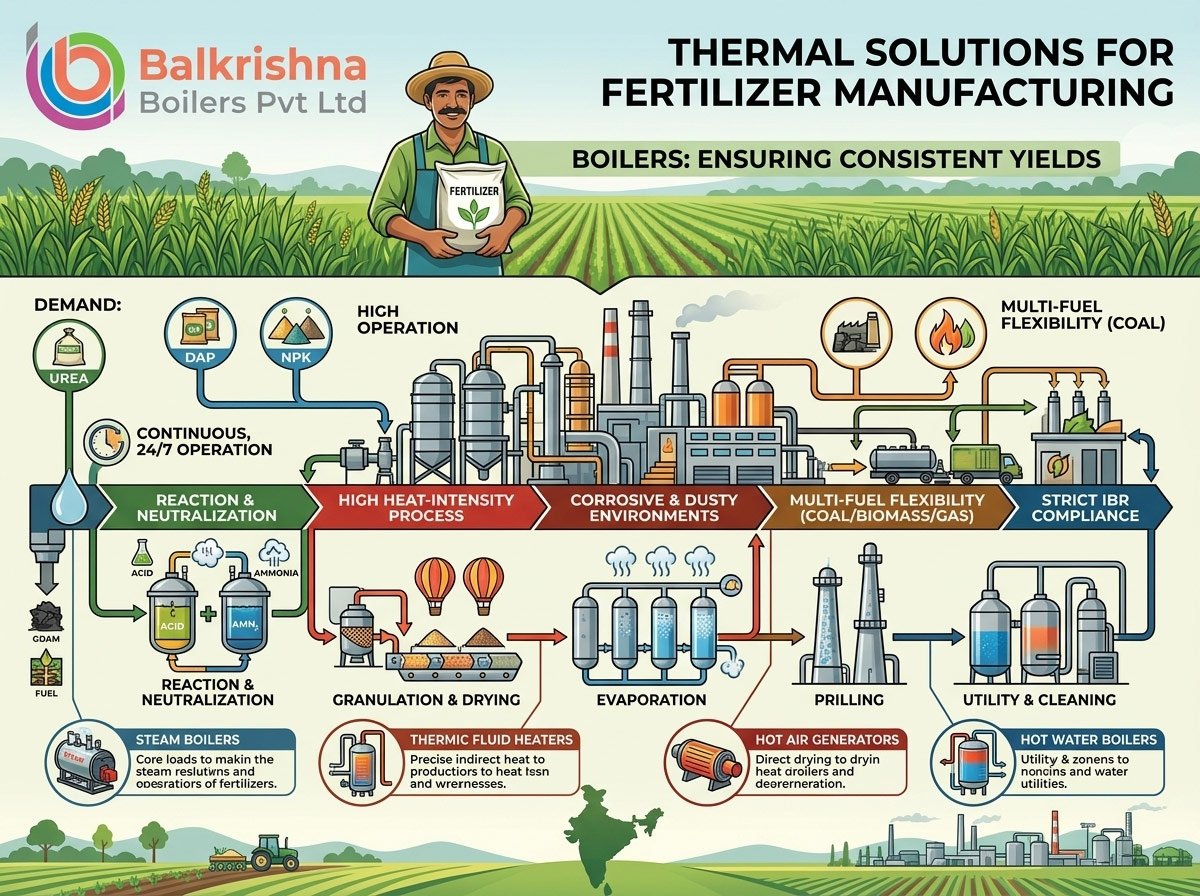
India feeds its fields before it feeds its people, and behind every bag of urea, DAP, NPK, or SSP leaving a plant is a thermal system working around the clock. Fertilizer manufacturing is one of the most heat-intensive and continuous-process industries in the country. A single unplanned shutdown in the boiler house doesn’t just cost production hours — it can disrupt a granulation line, spoil a batch mid-reaction, or delay dispatches during a sowing season when every day matters to farmers waiting on supply.
Unlike industries where heat is a support function, in fertilizer production, thermal energy is often part of the core chemistry. That difference changes what a plant needs from its boiler — and it’s why generic, off-the-shelf thermal equipment frequently underperforms in this sector. This guide looks at where heat is actually used in fertilizer manufacturing, which boiler technologies fit which stage, and how plants across India are engineering their utilities for reliability, fuel flexibility, and compliance.
Why the Fertilizer Industry Places Unique Demands on Boilers
Fertilizer plants typically run 24×7, often for 300+ days a year, because shutting down and restarting a urea or ammonia-linked process is expensive and technically disruptive. This creates a few non-negotiable requirements for the boiler house:
Continuous, stable steam supply. Reaction stages, evaporation, and drying all depend on steam that doesn’t fluctuate in pressure or temperature. Even short dips can affect product moisture content and granule quality.
High thermal loads at consistent parameters. Many fertilizer processes need steam at specific, tightly held pressure bands — not “close enough,” but consistent, batch after batch.
Corrosive and dusty operating environments. Ammonia, sulfuric acid mist, phosphoric compounds, and fine particulate from granulation and bagging sections are hard on equipment. Boiler and heater construction materials, insulation, and instrumentation need to be specified with this in mind, not treated as an afterthought.
Fuel cost sensitivity. Fertilizer is a volume, thin-margin business. Plants are constantly evaluating coal, biomass (husk, agro-waste, briquettes), furnace oil, and gas against delivered cost per tonne of steam — and increasingly, against emission norms.
Strict statutory compliance. IBR (Indian Boilers Regulation) approval, pressure vessel safety, and pollution control clearances are mandatory, not optional, for any thermal equipment feeding a chemical process plant.
These factors are strikingly similar to what we’ve seen in other continuous-process, chemically demanding sectors — our recent piece on boilers for sugar mills covers a related challenge: high-volume, fuel-flexible steam generation under constant load, and it’s worth a read if you’re benchmarking utility design across process industries.
Where Heat Is Actually Used in Fertilizer Manufacturing
To specify the right thermal equipment, it helps to map heat demand across the plant rather than treat “boiler capacity” as one number.
1. Steam for Reaction and Neutralization Stages
In SSP, DAP, and NPK complex fertilizer production, steam is used in reaction vessels and neutralizers to maintain temperature during acid-ammonia or acid-rock reactions. Pressure stability here directly affects reaction completeness and product consistency.
2. Granulation and Drying
After the reaction stage, wet granules need controlled drying to hit target moisture content. This is one of the largest thermal loads in the plant and is typically met with a combination of steam-heated air and direct hot air systems, depending on the fertilizer grade being produced.
3. Evaporation and Concentration
Processes that concentrate liquid streams — common in phosphoric acid handling and certain NPK routes — depend on multiple-effect evaporators fed by steam at defined pressure. Efficiency losses here compound quickly if boiler output isn’t stable.
4. Prilling and Cooling Support Systems
Urea prilling towers and cooling circuits often need auxiliary heat for startup and process stabilization, particularly in colder months or during plant restart after maintenance.
5. Bagging, Utility, and Space Heating
Smaller but still important: warehouse and bagging area conditioning, wash-down hot water, and utility steam for cleaning acid-handling equipment.
Each of these load types can call for a different combination of equipment — which is why most fertilizer plants don’t run on a single boiler type, but on a matched set of thermal systems.
Matching Boiler Technology to Fertilizer Plant Needs
Steam Boilers: The Core of the Utility
For the reaction, neutralization, and evaporation loads described above, a robust steam boiler is the backbone of most fertilizer plant utilities. Depending on fuel availability and load size, plants typically choose between:
- Multi-fuel and biomass-fired steam boilers, such as the HUSKPOWER or PELLETAX ranges, for plants near agricultural belts with steady access to husk, briquettes, or agro-residue — a strong option for reducing fuel cost per tonne of steam without compromising output stability.
- High-capacity coal or solid-fuel boilers, like STEAMPOWER or ENERPOWER, for larger integrated fertilizer complexes running continuous, high-tonnage steam demand.
- Compact and packaged steam boilers, such as STEAMJET or COMCUBE, for smaller SSP or blending units where floor space and faster commissioning matter as much as capacity.
Boiler selection isn’t just about tonnes-per-hour — pressure rating, turndown ratio, and response time to load swings matter just as much in a plant where reaction stages can’t tolerate steam pressure drift.
Thermic Fluid Heaters: For Indirect, Precise Process Heat
Some fertilizer processes — particularly indirect heating in reaction jackets, certain drying applications, and processes where direct steam contact isn’t desirable — are better served by a thermic fluid heater rather than steam. Thermic fluid systems offer very tight temperature control at relatively low system pressure, which reduces the risk profile around corrosive process areas.
Models like the VTF Series, VTM Series, and THERMPAC are commonly specified where a plant needs closed-loop, high-temperature heat transfer without the scaling and treatment overhead that comes with high-pressure steam circuits.
Hot Air Generators: For Direct Drying Loads
Granulation drying and certain bagging-area processes often use direct-fired hot air generators rather than steam-to-air heat exchange, simply because direct hot air can be more fuel-efficient for high-volume drying duty. Ranges such as AIRPOWER, AIRTHERM, and AIRJET are engineered for exactly this kind of continuous, high-throughput drying application.
Hot Water Boilers: For Utility and Wash-Down Needs
While not the primary process load, hot water boilers — such as the AQUAMAX or VST Series — support cleaning, equipment wash-down, and general utility hot water needs around acid and reaction handling areas, where hygiene and corrosion control both matter.
Fuel Flexibility: A Real Cost Lever for Fertilizer Plants
Fuel is typically the single largest recurring cost in a fertilizer plant’s utility budget, which is why fuel-flexible boiler design deserves serious attention at the specification stage rather than being revisited only after a fuel price shock.
Plants located near agricultural regions frequently shift a meaningful share of their thermal load to biomass — husk, mustard stalk, cotton stalk, or agro-briquettes — both for cost control and to support sustainability targets. We’ve seen this same logic play out in cotton ginning and spinning mills and edible oil and solvent extraction plants, where multi-fuel boiler design lets plants respond to seasonal fuel availability instead of being locked into a single, price-volatile input.
For fertilizer plants specifically, a well-designed multi-fuel steam boiler can typically switch between coal, biomass, and briquettes with minimal derating — giving procurement teams real negotiating leverage rather than dependence on a single supplier or fuel market.
Safety, Compliance, and Material Selection
Because fertilizer manufacturing involves ammonia, sulfuric and phosphoric compounds, and fine corrosive dust, boiler and heater specification needs to go beyond standard industrial-grade construction:
- IBR certification is mandatory for any pressure boiler feeding a chemical process area — this isn’t a paperwork formality, it governs design, welding, and inspection standards that directly affect plant safety.
- Corrosion-resistant materials and coatings on external surfaces, ducting, and instrumentation reduce maintenance downtime in ammonia and acid-exposure zones.
- Dust and particulate management around the boiler house — including combustion air intake design — matters more in a fertilizer plant than in cleaner process industries, and should be part of the boiler layout discussion, not an afterthought.
- Pollution control integration — bag filters, dust collectors, ESPs, or wet scrubbers — is typically required alongside the boiler itself to meet emission norms for solid-fuel or coal-fired systems.
These considerations mirror what we’ve detailed for other chemically aggressive environments, including our guide on boilers for the ceramics and tiles industry, where high-particulate, high-duty-cycle operation demanded similar attention to material selection and emissions control.
Sizing and Selecting the Right System: What Plants Should Evaluate
Before finalizing a thermal system for a fertilizer unit, it’s worth working through a structured checklist rather than sizing on peak demand alone:
- Map every heat load separately — reaction/neutralization, drying, evaporation, and utility — instead of totaling them into one number. Different loads often call for different equipment types, not one oversized boiler.
- Confirm pressure and temperature tolerance for each process stage. Reaction and evaporation stages are usually far less forgiving of fluctuation than utility heating.
- Evaluate fuel availability over a 12-month cycle, not just current pricing — biomass availability can be seasonal, and a multi-fuel-capable boiler protects against supply gaps.
- Factor in redundancy. Given the cost of unplanned downtime in a continuous chemical process, many fertilizer plants run a primary boiler plus a smaller standby unit rather than a single large system with no backup.
- Confirm IBR approval and after-sales service response time before finalizing a vendor — a boiler that can’t be serviced quickly in a 24×7 plant is a liability, regardless of its specifications on paper.
Why Plants Choose Balkrishna Boilers for Fertilizer Applications
Balkrishna Boilers Pvt Ltd has engineered thermal systems for fertilizer and chemical process plants that need to run continuously under demanding, corrosive conditions. Our steam boiler, thermic fluid heater, and hot air generator ranges are built with fuel flexibility, IBR compliance, and corrosion-aware construction in mind — because in this industry, downtime isn’t measured just in production hours, it’s measured in disrupted supply chains reaching all the way to the farm gate.
To see the range of industries we support, visit our Industries page, or browse the complete product catalogue on balkrishn.com for detailed specifications on individual models.
If you’re evaluating a new thermal system or looking to upgrade an existing fertilizer plant utility, our engineering team can help you map your specific load profile against the right combination of equipment. Get in touch with us to discuss your requirement.
Related Reading: