
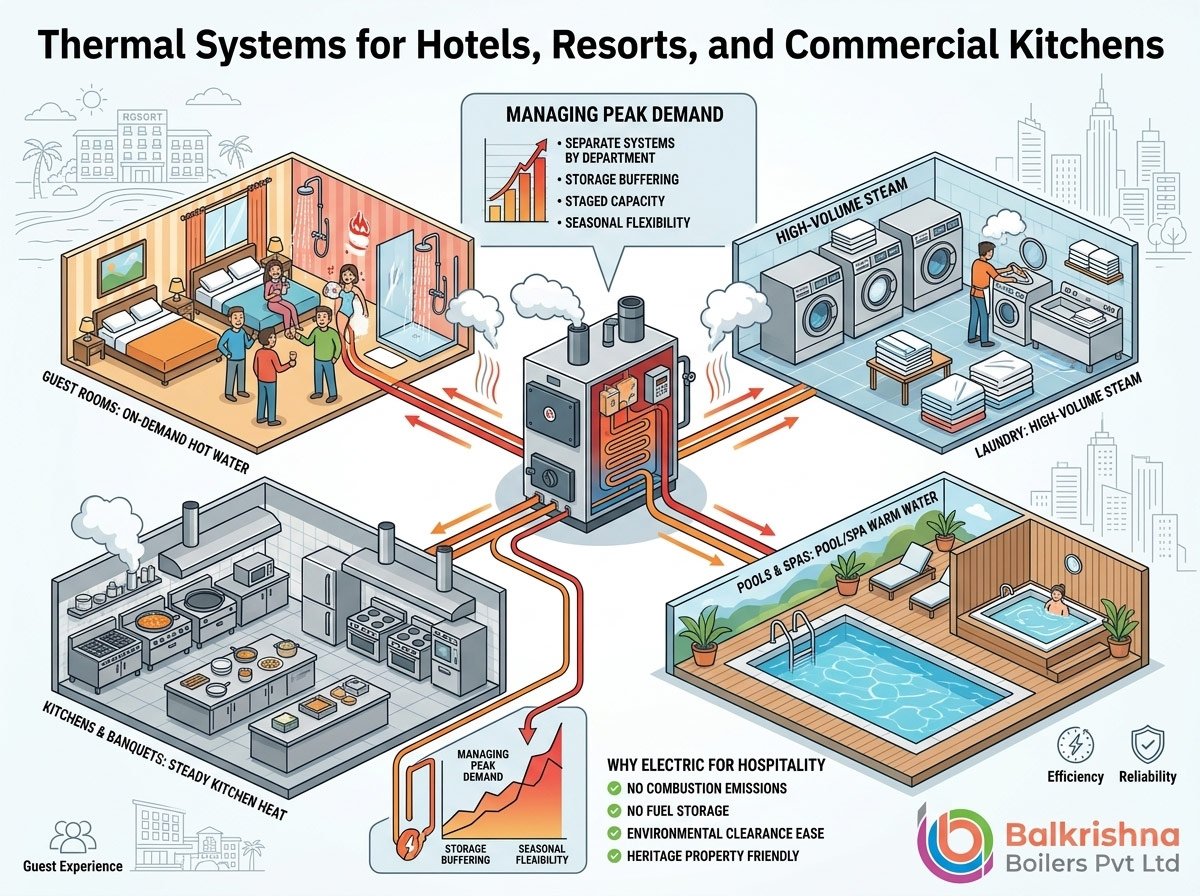
A guest doesn’t think about the boiler room until the shower runs cold. In hospitality, thermal systems sit almost entirely behind the scenes — but they touch nearly every part of the guest experience and back-of-house operation at once: hot water on demand in every room, steam for the laundry that turns around thousands of linens a day, heat for a commercial kitchen running breakfast through late-night room service, and warm water for pools and spas that guests expect to be ready the moment they walk in.
Unlike a factory with one dominant process, a hotel or resort runs several thermal demands in parallel, each with a different pattern of peaks and lulls. Guest hot water spikes hard in the morning and evening. Kitchen demand follows meal service. Laundry runs in scheduled batches. Pool and spa heating needs to hold steady around the clock. Getting the boiler system wrong doesn’t just hurt efficiency — it shows up directly in guest reviews. This guide walks through what hospitality properties actually need from their thermal systems and which equipment fits each part of the operation.
Why Hospitality Thermal Demand Is Harder to Size Than It Looks
A mid-sized hotel or resort typically runs several distinct heat demands through the same property:
- Guest room hot water — sharp morning and evening peaks as guests shower before and after the day, with occupancy directly driving demand.
- Commercial kitchen operations — steam and heat for cooking, dishwashing, and food prep across breakfast, lunch, dinner, and often 24-hour room service.
- Laundry — high-volume steam demand for linens, towels, and uniforms, typically run in scheduled batches rather than continuously.
- Pool and spa heating — a steady, round-the-clock load rather than a sharp peak, but one that guests notice immediately if it drops.
- Space heating — in hill stations, cooler regions, and winter-season properties, central heating adds another layer of continuous demand.
The peaks rarely line up neatly. A resort’s morning guest shower peak can overlap with breakfast kitchen demand and an early laundry batch — three separate systems all pulling heat at once. That overlap is exactly why most well-run hotel boiler rooms split these loads across dedicated systems rather than running everything off a single oversized boiler.
Steam Boilers: Laundry, Kitchens, and Larger Properties
For hotels and resorts running an in-house laundry and a full commercial kitchen, a steam boiler is usually the central utility. Steam distributes easily through a single header to multiple departments — laundry, kitchen, and even guest floor heating in some properties — with pressure regulated separately at each point of use.
Compact, fast-recovery ranges like STEAMAX and STEAMGEN suit boutique and mid-sized hotels where laundry and kitchen steam run in scheduled bursts rather than continuously. Larger resorts and five-star properties running laundry, multiple kitchens, and banquet operations simultaneously often need the higher sustained output of ranges like COMBIPOWER or STEAMPOWER, sized to cover peak demand across departments without one operation starving another of steam.
Properties in regions with reliable biomass supply sometimes also look at agro-fuel options like HUSKPOWER to manage fuel costs on a large, continuous laundry and kitchen operation — worth evaluating where fuel logistics make sense for the property’s location.
Hot Water Boilers: Where Guest Experience Actually Lives
If there’s one system a hotel genuinely cannot afford to get wrong, it’s guest room hot water. A hot water boiler, run as a dedicated system separate from kitchen and laundry steam, keeps guest floors supplied through the sharp morning and evening peaks without competing against kitchen or laundry demand at the same time of day.
Ranges such as AQUAJET and AQUAMAX are commonly specified for this continuous, high-demand hot water duty across guest floors, while the compact VST Series fits properties with limited utility space, such as boutique hotels retrofitting an older building. Resorts with pools and spas often extend this same hot water loop, or run a parallel dedicated system, to keep pool and spa temperature steady around the clock — a load that behaves very differently from the sharp peaks of guest room demand and is worth sizing separately rather than folding into the same calculation.
Thermic Fluid Heaters: Commercial Kitchens and Banquet Operations
Large commercial kitchens — particularly those running big-batch cooking for banquets, buffets, and room service — often benefit from a thermic fluid heater for jacketed cooking equipment. Indirect heating through a thermic fluid loop gives kitchen staff steadier, more controllable heat than direct steam injection, with less risk of scorching large volumes during a busy banquet service or breakfast rush.
Ranges like DELTAPAC and THERMPAC suit hotel kitchens running multiple large cooking vessels through tight service windows, while compact vertical options such as the VTF Series work well where kitchen floor space is at a premium. If you’re deciding between a thermic fluid system and steam for a large kitchen operation, our earlier post <a href=”https://www.indianboilers.com/thermic-fluid-heater-vs-steam-boiler-which-suits-your-process/”>Thermic Fluid Heater vs Steam Boiler: Which Suits Your Process?</a> covers the trade-off, and <a href=”https://www.indianboilers.com/what-is-a-thermic-fluid-heater-and-how-is-it-used/”>What is a Thermic Fluid Heater and How is It Used?</a> is a useful starting point if this is new territory for your facilities team.
Electric Boilers: A Strong Fit for Boutique Hotels and Heritage Properties
Boutique hotels, heritage properties, and resorts in scenic or environmentally sensitive locations increasingly turn to electric boilers for reasons that go well beyond running cost. No combustion means no flue gas, no fuel storage, and no boiler room built around fuel logistics — which matters directly for a heritage property with limited structural space, or a resort in a hill station or coastal location where air quality and environmental clearance carry real weight.
Ranges such as ELECTROMAX and ELECTROPAC give smaller and mid-sized properties precise, near-instant hot water and steam without the operational overhead of fuel handling, while compact options like ELECTROAQUA suit smaller guest wings or spa areas retrofitted into an older structure. Properties operating in designated eco-sensitive zones or tourist areas with tighter emission norms will find the case laid out in <a href=”https://www.indianboilers.com/how-electric-boilers-help-meet-pollution-control-norms/”>How Electric Boilers Help Meet Pollution Control Norms</a> directly relevant, and the broader shift toward electric systems is covered in <a href=”https://www.indianboilers.com/future-of-electric-boilers-in-indias-green-manufacturing-push/”>Future of Electric Boilers in India’s Green Manufacturing Push</a> — a trend hospitality is following alongside manufacturing.
For properties weighing the switch, <a href=”https://www.indianboilers.com/electric-boiler-roi-when-does-it-pay-off/”>Electric Boiler ROI: When Does It Pay Off?</a> and <a href=”https://www.indianboilers.com/electric-boiler-power-consumption-formulas-and-examples/”>Electric Boiler Power Consumption: Formulas and Examples</a> help with the cost comparison, while <a href=”https://www.indianboilers.com/electric-boiler-installation-what-to-expect/”>Electric Boiler Installation: What to Expect</a> and <a href=”https://www.indianboilers.com/electric-boiler-water-quality-requirements-explained/”>Electric Boiler Water Quality Requirements Explained</a> cover what to plan for once a decision is made — water quality matters as much here as anywhere, since scale buildup on immersed elements directly affects both efficiency and guest-facing hot water reliability.
Managing Peak Demand Without Oversizing the Whole System
The instinct in hospitality is often to size the boiler system for the absolute worst-case moment — full occupancy, breakfast service, and a laundry batch all running at once. That approach works, but it usually means paying for capacity that sits idle most of the year. A better approach most properties land on:
- Separate systems by department — guest hot water, kitchen, and laundry each on their own boiler or loop, so a peak in one doesn’t starve another.
- Storage buffering — insulated hot water storage tanks that get charged during low-demand periods and drawn down during the morning and evening peaks, smoothing out the load on the boiler itself.
- Staged capacity — running smaller boilers in combination rather than one oversized unit, so the system can match actual demand through the day instead of running one large boiler at partial load most of the time.
- Seasonal flexibility — resorts with strong seasonal occupancy swings benefit from systems that can be throttled down efficiently during low season rather than running at a fixed high output year-round.
This kind of layered approach tends to serve hospitality properties better than a single large boiler sized for the busiest day of the year, which spends most of its operating life running well below capacity.
Fuel Choice: What Actually Makes Sense for a Hospitality Property
Fuel selection for hotels and resorts usually comes down to location, guest expectations, and regulatory environment as much as raw cost:
- Gas-fired systems offer clean combustion and fast response, a common choice for urban hotels and mid-sized resorts where reliable gas supply is available.
- Biomass-fired systems suit larger resorts with space for fuel storage and handling, particularly where cost control on a large, continuous laundry and kitchen operation matters.
- Electric systems remove combustion entirely — increasingly the preferred choice for eco-resorts, heritage properties, and hotels in tourist zones where environmental clearance and guest-facing sustainability credentials are part of the brand.
Many properties don’t choose one exclusively — a fuel-fired steam system handles the heavy kitchen and laundry load, while a smaller electric system covers guest wings, spa areas, or seasonal capacity that doesn’t justify running the main boiler at low load.
Why Hotels, Resorts, and Commercial Kitchens Work With Balkrishna Boilers
Balkrishna Boilers Pvt Ltd has spent over two decades engineering thermal systems for facilities where reliability and guest-facing service quality are inseparable from the boiler room — the same standard hospitality properties hold themselves to. Our <a href=”https://www.indianboilers.com/industries/”>industries page</a> covers the wider range of sectors we serve, and our <a href=”https://balkrishn.com/client.php”>client list</a> reflects installations across food service, process, and commercial facilities operating under similarly high uptime and hygiene expectations.
Whether your property needs a central steam system for kitchen and laundry, a dedicated hot water loop for guest floors and spa, or an electric system built around a heritage building’s space and environmental constraints, our team can help design the right combination rather than sizing a single unit in isolation.
Frequently Asked Questions
What size boiler does a mid-sized hotel need? It depends on room count, occupancy pattern, and whether the property runs its own laundry and full kitchen — but the right approach is sizing guest hot water, kitchen, and laundry as separate loads rather than one combined estimate, since their peaks rarely line up perfectly.
Are electric boilers practical for a boutique hotel? Yes, particularly where space is limited, environmental clearance is a factor, or the property doesn’t want a fuel-handling boiler room built into a heritage structure — electric systems handle guest hot water and smaller kitchen or spa loads well.
Can one boiler handle both the kitchen and guest room hot water? It can in smaller properties, but as occupancy grows, most hotels separate these onto dedicated systems so a kitchen or laundry peak doesn’t leave guest floors short on hot water during check-in or check-out hours.
How often should hotel boilers be serviced? Given continuous guest-facing demand, monthly inspection is recommended, with a full annual service and water-quality check to prevent scale buildup and avoid unexpected downtime during peak occupancy periods.
Planning a new hotel or resort boiler room, or reviewing capacity ahead of a busy season? <a href=”https://www.indianboilers.com/contact-us/”>Get in touch with our engineering team</a> or explore our full <a href=”https://balkrishn.com/ourProduct.php”>product range</a> to find the right fit for your property.