
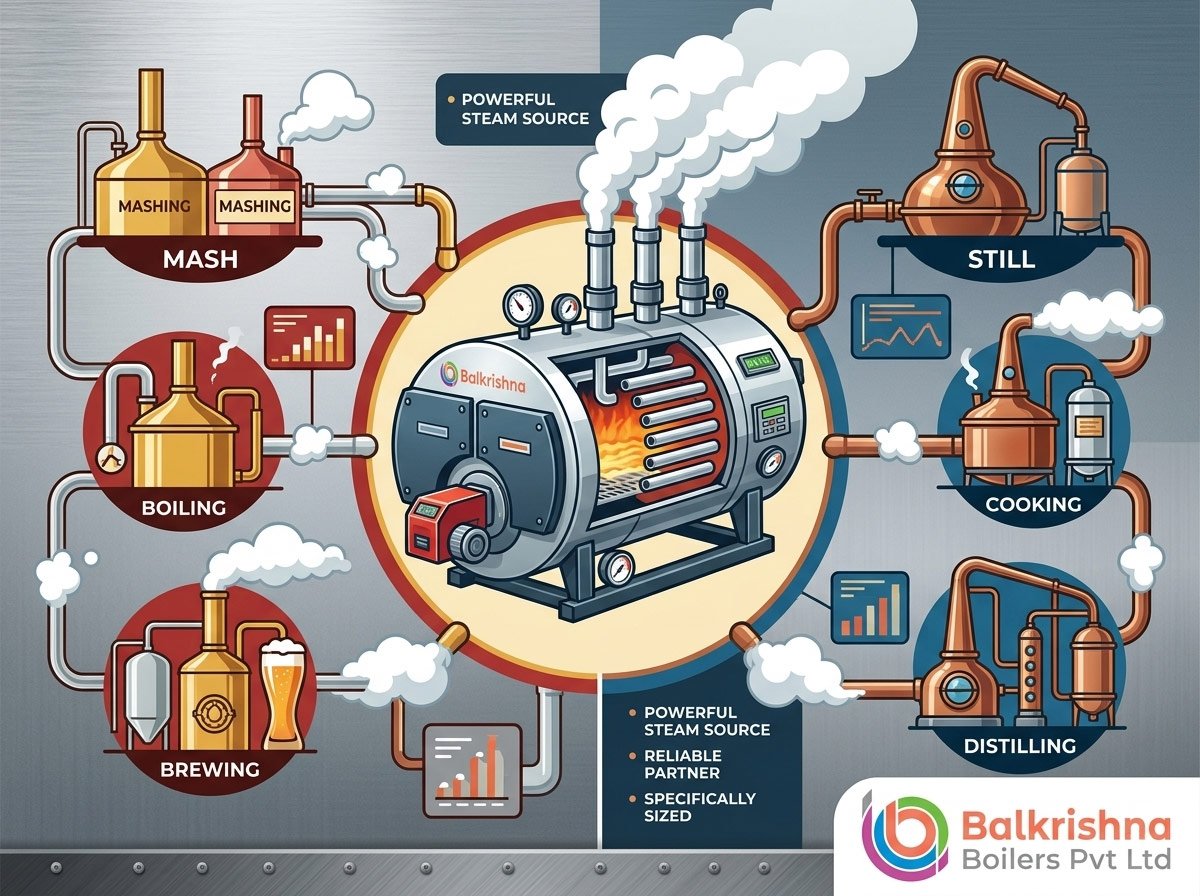
Walk into any brewery or distillery in India — from a craft microbrewery in Bengaluru to a molasses-based distillery in Uttar Pradesh — and you’ll find one piece of equipment quietly running behind every batch: the boiler. Mashing, wort boiling, fermentation temperature control, distillation, bottle washing, pasteurization, and clean-in-place (CIP) sanitation all depend on a steady, controllable supply of steam or hot water. Get the boiler wrong, and it shows up directly in the glass — inconsistent mash temperatures, scorched wort, contaminated batches, or a spirit that just doesn’t taste right.
Unlike a textile unit or a chemical plant, breweries and distilleries sit at the intersection of two very different pressures: food-grade hygiene and heavy thermal load. That combination narrows the list of boiler types that actually work well here. This guide walks through what breweries and distilleries need from their heating systems, which boiler technologies fit which process step, fuel choices that make sense for Indian plants, and how to size and select the right system.
Why Breweries and Distilleries Are Different From Other Process Industries
Most industrial boiler applications need heat for one or two process steps. A brewery or distillery, on the other hand, uses thermal energy across almost the entire production line:
- Mashing — converting starches to fermentable sugars needs precise, stable temperatures, usually in the 62–72°C range for beer or similar ranges for grain-based spirits.
- Wort boiling / mash cooking — a rolling boil for 60–90 minutes to sterilize, extract, and concentrate.
- Distillation — column stills and pot stills run on continuous steam injection or indirect heating for hours at a stretch.
- Pasteurization and bottle washing — shorter bursts of hot water or low-pressure steam, but non-negotiable on timing.
- CIP (Clean-in-Place) systems — hot water and steam cycles that sanitize tanks, lines, and fermenters between every single batch.
Every one of these steps has a different temperature, pressure, and purity requirement. That’s exactly why breweries and distilleries rarely run on a single boiler type — they typically combine a primary steam or thermic fluid system with a secondary hot water loop, sized and selected process by process.
Steam Boilers: The Workhorse for Mashing, Boiling, and Distillation
For most mid-to-large breweries and distilleries, a steam boiler remains the backbone of the plant. Steam is easy to distribute through pipework to multiple vessels at once, it transfers heat quickly and evenly across a jacketed mash tun or kettle, and it can be throttled precisely — critical when a 2–3°C swing in mash temperature can change the entire character of a batch.
Coil-type and smoke-tube steam boilers from ranges like STEAMAX, STEAMGEN, and STEAMPOWER are well suited to breweries that need fast steam-up time between shifts and reliable low-to-medium pressure steam for jacketed kettles and mash vessels. For distilleries running continuous column stills, higher-capacity ranges such as STEAMJET or COMBIPOWER handle the sustained, high-volume steam draw that distillation demands without pressure drop.
Many Indian distilleries — particularly molasses-based units near sugar mills — also run on agro-residue fuels for cost reasons. Bagasse, husk, and biomass-fired boilers like HUSKPOWER or PELLETAX let a distillery use locally available fuel while still meeting steam demand, which matters when fuel logistics and cost are as important as thermal output.
If you’re still weighing steam against indirect heating for your process, our earlier post on <a href=”https://www.indianboilers.com/thermic-fluid-heater-vs-steam-boiler-which-suits-your-process/”>Thermic Fluid Heater vs Steam Boiler: Which Suits Your Process?</a> breaks down the trade-off in more detail — it’s a useful starting point before finalizing your system.
Thermic Fluid Heaters: Where Indirect, Even Heat Matters
Not every heating step in a brewery or distillery wants direct steam contact. Wort boiling kettles, jacketed cookers, and certain evaporation or concentration steps in distillery spent-wash treatment benefit from indirect heating, where hot thermic fluid circulates through a jacket or coil rather than steam contacting the product directly.
A thermic fluid heater offers a few real advantages here: no risk of water hammer or condensate contamination in the product line, closer control over surface temperature (reducing the risk of scorching sugars in a wort boil), and lower operating pressure than a comparable steam system, which simplifies compliance and reduces boiler-attendant requirements.
Ranges like THERMPAC and DELTAPAC are commonly specified for jacketed cooking and concentration duties, while vertical models such as the VTF Series or VFF Series work well where floor space around the process vessels is tight. If your distillery also runs a spent-wash concentration or evaporation line, a thermic fluid system is often the more stable choice for that duty compared to raising steam pressure just for one step. For a broader look at how these systems work, see our earlier article, <a href=”https://www.indianboilers.com/what-is-a-thermic-fluid-heater-and-how-is-it-used/”>What is a Thermic Fluid Heater and How is It Used?</a>
Hot Water Boilers and CIP: The Step Everyone Underestimates
Ask any brewmaster where the boiler actually earns its keep day to day, and CIP is usually the honest answer. Between every batch, tanks, fermenters, lines, and heat exchangers need a hot water and sanitizer cycle — and that demand is constant, predictable, and unforgiving on downtime. A brewery that can’t hit CIP temperature on schedule loses an entire batch slot.
A dedicated hot water boiler, separate from your primary steam system, keeps CIP running on its own loop without competing for capacity with mashing or distillation. Models like AQUAJET and AQUAMAX are sized for exactly this kind of continuous hot water draw, while the VST Series suits plants that need a vertical, compact footprint near the fermentation and packaging area.
Running CIP off a separate hot water system rather than bleeding steam off your main boiler also protects your mash and distillation schedule — a genuinely practical reason many mid-size breweries add a second, smaller unit as they scale up.
Electric Boilers: A Fit for Craft Breweries and Hygiene-First Operations
Craft breweries, contract packaging units, and premium spirit producers increasingly look at electric boilers for a specific reason: cleanliness and control. An electric boiler has no combustion, no flue gas, and no fuel storage on site — which matters in urban craft breweries where space is tight and food-safety audits scrutinize every possible contamination path.
Ranges such as ELECTROMAX and ELECTROPAC give smaller breweries precise, near-instant steam or hot water without a boiler room built around fuel handling. The trade-off, as always, is running cost per unit of energy — which is why most operators size an electric boiler for CIP, pasteurization, and smaller batch kettles rather than as the sole steam source for a large distillery. Our earlier post, <a href=”https://www.indianboilers.com/electric-boiler-roi-when-does-it-pay-off/”>Electric Boiler ROI: When Does It Pay Off?</a>, walks through exactly this kind of cost-versus-convenience calculation.
Water purity also matters more with electric boilers than most operators expect, since scale buildup on immersed elements directly affects heat transfer and lifespan — a topic we cover in <a href=”https://www.indianboilers.com/electric-boiler-water-quality-requirements-explained/”>Electric Boiler Water Quality Requirements Explained</a>, which is worth reading alongside this one if you’re evaluating an electric system for a hygiene-sensitive brewhouse.
Hot Air Generators: Malt Drying and Grain Handling
Distilleries and breweries that process their own grain — malting, kilning, or drying spent grain for animal feed resale — need dry, controlled hot air rather than steam or water. A hot air generator handles this separately from the main thermal system, and models like AIRPAC or AIRMAX are commonly used for kilning and grain-drying duties where direct or indirect hot air replaces a conventional dryer.
For distilleries selling dried distillers’ grains (DDGS) as a by-product, a properly sized hot air generator can turn a waste-handling cost into a revenue stream — a detail that’s easy to overlook when the initial focus is only on the mashing and distillation boiler.
Fuel Choice: Balancing Cost, Compliance, and Local Supply
Fuel selection in breweries and distilleries usually comes down to three factors: what’s locally available, what regulatory bodies in the state allow, and how consistent the plant’s production schedule is.
- Biomass and agro-residue (husk, bagasse, briquettes) suit distilleries near agricultural belts with steady access to fuel and lower per-unit cost, though they need more attendant supervision and ash handling.
- Oil and gas-fired systems offer cleaner combustion and faster response, useful where emission norms are tighter or where the plant is in an urban or semi-urban industrial zone.
- Electric systems eliminate combustion entirely, which is increasingly attractive as state pollution control boards tighten norms — a trend we cover in more depth in <a href=”https://www.indianboilers.com/future-of-electric-boilers-in-indias-green-manufacturing-push/”>Future of Electric Boilers in India’s Green Manufacturing Push</a>.
Most breweries and distilleries don’t pick one fuel exclusively — they run a primary fuel-fired steam or thermic fluid system for the heavy mashing/distillation load, and a smaller electric or gas unit for hygiene-critical CIP and pasteurization duty.
Sizing: Don’t Just Add Up Nameplate Capacities
A common mistake in brewery and distillery boiler selection is sizing the system by simply adding up the rated demand of every vessel. In practice, mashing, boiling, CIP, and distillation rarely peak at the exact same moment — but they do overlap enough that undersizing causes real production delays. A proper sizing exercise accounts for:
- Batch cycle time and how many vessels draw steam or hot water simultaneously during a shift
- Startup steam demand versus steady-state process demand
- Reserve capacity for CIP running alongside a mash or boil cycle
- Seasonal variation, especially for distilleries that scale up production around harvest season for feedstock availability
This is exactly the kind of calculation worth doing with an engineering team before finalizing a boiler order, rather than after installation when a shortfall shows up as a bottleneck on the production floor.
Why Breweries and Distilleries Work With Balkrishna Boilers
Balkrishna Boilers Pvt Ltd has spent over two decades engineering thermal systems for process-heavy, hygiene-sensitive industries — including food and beverage plants that share the same core requirements as breweries and distilleries: consistent steam quality, fast response between batches, and equipment that holds up to daily CIP cycles. Our <a href=”https://www.indianboilers.com/industries/”>industries page</a> covers the broader range of sectors we serve, and our <a href=”https://balkrishn.com/client.php”>client list</a> includes plants across food processing, pharmaceuticals, and process manufacturing where the same hygiene and reliability standards apply.
Whether your plant needs a single high-capacity steam boiler for distillation, a combination of steam and hot water systems for a growing craft brewery, or a full thermal package spanning mashing, CIP, and grain drying, our team can help size and specify the right combination of equipment for your process — not just sell a single unit.
Frequently Asked Questions
What type of boiler is best for a craft brewery? Most craft breweries do well with a mid-capacity steam boiler such as STEAMAX or STEAMGEN for mashing and wort boiling, paired with a smaller electric or hot water unit dedicated to CIP and pasteurization.
Can one boiler handle both mashing and CIP in a small distillery? Yes, in smaller operations a single steam boiler can serve both, but as production scales, most plants add a dedicated hot water system for CIP so cleaning cycles don’t compete with mashing or distillation for steam capacity.
Is biomass fuel suitable for distillery boilers? Biomass and agro-residue fuels work well for distilleries with reliable local fuel supply, particularly those near sugar mills or agricultural processing belts, and can significantly reduce fuel cost compared to oil or gas.
How often should a brewery boiler be serviced? Given the daily CIP cycles and continuous operation typical in breweries, boilers should be inspected on a monthly basis at minimum, with a full annual service and water-quality check to prevent scale buildup and maintain efficiency.
Looking to size a steam, thermic fluid, or hot water system for your brewery or distillery? <a href=”https://www.indianboilers.com/contact-us/”>Get in touch with our engineering team</a> or explore our full <a href=”https://balkrishn.com/ourProduct.php”>product range</a> to find the right fit for your process.