
-
-

-

-
 Thermic Fluid Heater
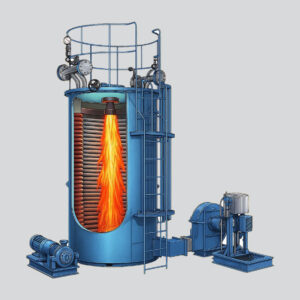
Vertical Three Pass Oil / Gas Fired Thermic Fluid Heater
₹500,000.00 Add to cart
The Thermic Fluid Heater: High Heat, Low Pressure
In many industrial processes, achieving high temperatures is a critical requirement. Traditionally, steam boilers have been the go-to solution. However, generating high-temperature steam requires exponentially increasing pressure, which introduces significant safety challenges, complex regulatory compliance, and robust, expensive piping infrastructure.
Enter the Thermic Fluid Heater, an industrial heating system designed to overcome these limitations. Its primary advantage, and the reason for its widespread adoption, is its ability to provide reliable process heat at very high temperatures while operating at near-atmospheric pressure.
The Core Principle: Staying in the Liquid Phase
Unlike a steam boiler that vaporizes water into steam to transfer heat, a thermic fluid heater uses a specialized organic or synthetic heat transfer fluid. This fluid is circulated in a closed-loop system.
The key difference lies in the physical properties of the fluid. Water boils at 100°C (212°F) at atmospheric pressure. To get steam to 300°C (572°F), you would need a pressure of nearly 85 bar (over 1200 psi).
In contrast, thermal fluids have a much higher boiling point at atmospheric pressure. They can be heated to temperatures ranging from 250°C to over 350°C (480°F to 660°F) while remaining in a liquid state. The only pressure in the system is the relatively low pressure required by the circulating pump to move the fluid through the piping.
The chart above illustrates this dramatic difference. As you can see, for a given high temperature, the thermal fluid system operates at a fraction of the pressure required by a steam system.
How the System Works
A typical thermic fluid heating system is a closed loop.
- Heater Unit: The thermal fluid is heated in a combustion chamber (fired by gas, oil, or biomass) or by electric heating elements. The fluid flows through helical coils to ensure maximum heat transfer and prevent overheating of the film layer.
- Circulating Pump: A high-temperature pump continuously circulates the hot fluid to the various heat users (process equipment like reactors, dryers, or presses).
- Heat Users: The hot fluid transfers its thermal energy to the process and then returns to the heater to be reheated.
- Expansion Tank: As the fluid heats up, it expands. An expansion tank is connected to the system to accommodate this increased volume and maintain a blanket of inert gas (like nitrogen) over the fluid to prevent oxidation.
Key Advantages over Steam Systems
The “high heat, low pressure” characteristic translates into several practical benefits:
-
Increased Safety: Operating at low pressure significantly reduces the risk of catastrophic pressure vessel failures and steam explosions.
-
Reduced Capital Costs: The system does not require the heavy-walled piping, high-pressure valves, and complex safety controls mandated for high-pressure steam boilers.
-
No Corrosion or Freezing: Thermal fluids are typically non-corrosive and have low freezing points, eliminating common issues associated with water and steam condensate.
-
High Efficiency: Closed-loop operation means virtually no heat is lost via blowdown or condensate discharge, leading to high overall system efficiency.
-
Precise Temperature Control: The liquid phase allows for very uniform and controllable heat transfer to the process.
Typical Applications
Thermic fluid heaters are the preferred choice in industries requiring high, uniform temperatures, such as:
-
Chemical & Petrochemical: Heating reactors, distillation columns, and storage tanks.
-
Textiles: Heating stenter frames for fabric drying and setting.
-
Food & Beverage: Heating fryers, ovens, and deodorizers for edible oils.
-
Wood Processing: Heating presses for plywood and MDF production.
-
Asphalt & Bitumen: Maintaining temperature in storage tanks and mixing plants.
Frequently Asked Questions
How does a Thermic Fluid Heater work?
The heater consists of a combustion chamber (for fuel) or an electric chamber. The heat source warms a helical coil through which the thermal oil flows. A high-temperature pump then circulates this hot oil to your equipment (like a reactor or press) and returns it to the heater to be reheated.
What is the maximum temperature a Thermic Fluid Heater can reach?
Most standard units at indianboilers.com are designed for temperatures up to 300°C. With specialized synthetic fluids and custom engineering, we can provide systems that reach up to 350°C or even 400°C.
Why use oil instead of water/steam?
The main reason is Temperature vs. Pressure. To get 300°C from steam, you would need a pressure of nearly 85 bar, which is dangerous and expensive. A thermic fluid heater can reach 300°C at near-atmospheric pressure (less than 5 bar).
Does a Thermic Fluid Heater require IBR (Indian Boiler Regulations) approval?
No. Because these systems operate at very low pressures and do not generate steam, they generally fall outside the purview of IBR. This means you don't need a certified boiler attendant or annual government inspections of the pressure vessel.
What is the difference between Vertical and Horizontal designs?
- Vertical: Ideal for plants with limited floor space.
- Horizontal: Preferred for high-capacity units (like our DELTAPAC series) as they offer easier access for coil maintenance and burner servicing.
What fuels can be used?
Our heaters are highly versatile. We offer models for:
- Liquid Fuels: Diesel (HSD), LDO, Furnace Oil.
- Gaseous Fuels: Natural Gas (PNG), LPG, Biogas.
- Solid Fuels: Coal, Wood, Rice Husk, Briquettes.
- Electric: Our ELECTROPAC series.
What is the typical thermal efficiency of these units?
Our three-pass and four-pass designs achieve efficiencies of 85% to 88% (NCV). By adding a Waste Heat Recovery Unit (WHRU), efficiency can be pushed as high as 92%.
How do you prevent the oil from "cracking" or degrading?
We use a Low Heat Flux design. By ensuring the oil flows at a high velocity through the coils, we prevent the "film temperature" from exceeding the oil's safety limit, which prevents carbonization.
What safety interlocks are included?
Every unit at indianboilers.com includes:
- Low Flow Switch: Shuts off the burner if oil stops circulating.
- High Temperature Cut-off: Prevents overheating.
- Expansion Tank Level Switch: Ensures enough oil is in the system.
- Stack Temperature Monitor: To detect heat waste.
How long does the thermic fluid last?
With proper maintenance, high-quality mineral oil lasts 3 to 5 years, while synthetic oils can last 8 to 10 years.
How often should I test my thermal oil?
We recommend a "Fluid Analysis" every 6 months. This checks for flash point changes, viscosity, and carbon content to ensure your system stays efficient and safe.
Which industries use Thermic Fluid Heaters?
They are essential in:
- Textiles: For stenters and drying.
- Chemicals: For jacketed reactors.
- Plywood: For hot presses.
- Food Processing: For industrial frying and ovens.
- Asphalt: For bitumen heating.
Can I produce steam using a Thermic Fluid Heater?
Yes. You can use an Unfired Steam Generator (USG). The hot oil passes through the USG to boil water, giving you steam for your process without the need for an IBR-fired boiler.
What is the typical price of a Thermic Fluid Heater in India?
The price depends on the capacity (kcal/hr) and fuel type. For 2025, the approximate starting rates are:
- Small (1 Lac - 2 Lac kcal/hr): ₹3.5 Lakh – ₹6 Lakh.
- Medium (5 Lac - 10 Lac kcal/hr): ₹8 Lakh – ₹15 Lakh.
- Large (20 Lac+ kcal/hr): ₹25 Lakh and above.
How does the price of Electric vs. Oil-fired models compare?
Electric models (ELECTROPAC) have a lower initial capital cost but higher running costs depending on your local electricity tariff. Oil/Gas models have a higher initial cost due to the burner and fuel system but offer lower operational costs in many regions.
What factors influence the final quote?
- Kcal/hr Capacity.
- Type of Burner (Imported vs. Indian).
- Automation Level (Standard Panel vs. PLC/SCADA).
- Accessories (Expansion tanks, de-aerators, and chimneys).
What is the typical ROI (Return on Investment)?
Due to high efficiency and the absence of water treatment costs, most industries see a payback within 12 to 18 months.
Do you provide installation and piping?
Yes. At indianboilers.com, we provide end-to-end solutions, including system design, chimney installation, and insulated pipeline networking.
How do I get a quote?
Simply visit the Contact Us page at indianboilers.com or email us your required temperature and heat load (kcal/hr). Our technical team will provide a customized proposal within 24 hours.
